How to use this calculator
Estimate how many years discounted project inflows take to recover an initial investment.
- Enter Initial investment ($), Annual net cash inflow ($), Annual discount rate (%), Project life (years). Match the units shown beside each field and review the result together with the assumptions below.
- Read the worked example below to check the expected input format and result.
- Compare another scenario by changing one input at a time. Use Reset to return to the starting values.
How this calculation works
Unlike simple payback, this method discounts each year’s expected cash inflow before accumulating it against the initial outlay. It reports the first recovery point and uses a within-year interpolation estimate.
Inputs and units
investment— Initial investment ($)- Up-front project outlay in dollars; enter a positive amount.
annualCashFlow— Annual net cash inflow ($)- Same nonnegative net inflow received at each year-end; zero means no inflow.
discountRatePct— Annual discount rate (%)- Annual discount rate used for each inflow (−50% to 1,000%).
years— Project life (years)- Whole number of annual inflows to include.
Formula
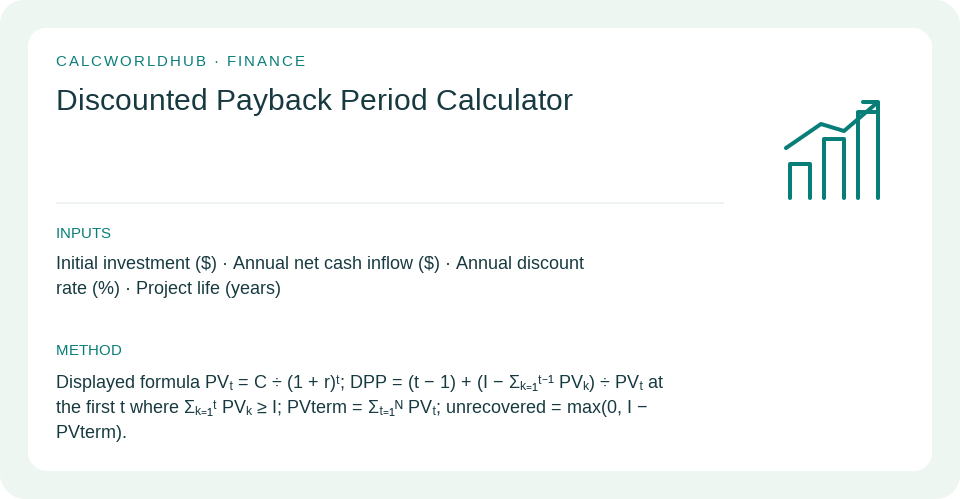
PVₜ = C ÷ (1 + r)ᵗ; DPP = (t − 1) + (I − Σₖ₌₁ᵗ⁻¹ PVₖ) ÷ PVₜ at the first t where Σₖ₌₁ᵗ PVₖ ≥ I; PVterm = Σₜ₌₁ᴺ PVₜ; unrecovered = max(0, I − PVterm).
Method
C is the same positive net cash inflow received at each year-end, I is the initial outlay, r is the annual discount rate as a decimal, and t is the year number. The calculator discounts each receipt, accumulates present values, then linearly interpolates the fraction of the year in which the discounted recovery threshold is crossed.
Worked example
With a $10,000 outlay, $3,500 year-end inflow, 8% discount rate, and five years, the discounted recovery time is about 3.38 years.
Assumptions and limits
Assumes equal positive cash inflows arrive at year-end and discounts at one annual rate. Fractional payback linearly interpolates within the crossing year; it is an estimate. It does not rank projects by NPV or model taxes, financing, uneven flows, or terminal value.
Frequently asked questions
How is discounted payback different from simple payback?
Each future inflow is reduced to present value before it is added toward recovery, so later cash counts less at a positive discount rate.
Why can the result include part of a year?
The calculator estimates the fraction of the crossing year needed to cover the remaining discounted outlay by linear interpolation.
What if recovery does not happen during the project life?
The result says it is not reached within the entered term and reports the present value of inflows and amount still unrecovered.
Is discounted payback the same as NPV?
No. It reports a recovery time. Net present value compares all discounted inflows and outflows as a currency amount.
How do I use the Discounted Payback Period Calculator?
Enter Initial investment ($), Annual net cash inflow ($), Annual discount rate (%), Project life (years). Match the units shown beside each field and review the result together with the assumptions below.
Reference: OpenStax Principles of Finance section on discounted payback period. See our calculation methodology.