Annualized return over risk-free calculator
Compare a compounded annual return with a matching annual reference rate.
Calculator
How to use this calculator
Estimate annualized compound return minus a user-entered annual comparison rate.
- Enter Beginning value ($), Ending value ($), Holding period (years), Risk-free annual rate (%). Match the units shown beside each field and review the result together with the assumptions below.
- Read the worked example below to check the expected input format and result.
- Compare another scenario by changing one input at a time. Use Reset to return to the starting values.
Annualize a holding-period return and subtract a reference rate
This calculator converts the beginning-to-ending value change into a compound annual growth rate, then subtracts the entered annual risk-free rate to report an excess-return estimate.
Inputs and units
- Beginning value ($): Positive starting value for the investment scenario.
- Ending value ($): Value at the end of the holding period; may be zero but not negative.
- Holding period (years): Positive elapsed time in years.
- Risk-free annual rate (%): Annual comparison rate for the same convention and period.
Formula and method
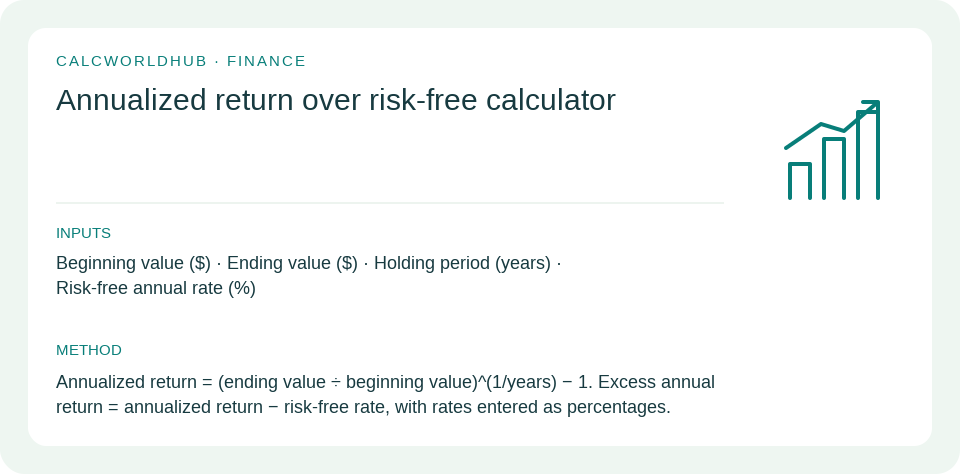
Annualized return = (ending value ÷ beginning value)^(1/years) − 1. Excess annual return = annualized return − risk-free rate, with rates entered as percentages.
Worked example
From $10,000 to $11,600 over 2 years, annualized return is √1.16 − 1 ≈ 7.7033%. Subtracting a 3% annual reference gives 4.7033 percentage points.
Interpreting the result
The result is a geometric annualized excess rate under the entered assumptions. It is not an expected future return or a risk-adjusted performance measure.
Assumptions and limits
The calculation excludes deposits, withdrawals, taxes, fees, dividends not reflected in ending value, inflation, and uncertainty. A risk-free benchmark must match currency, horizon, and compounding convention.
Method references
Frequently asked questions
Why use a square root for two years?
The annualized rate compounds for two equal years to reproduce the total growth factor.
Is a positive excess return proof of investment skill?
No. This simple comparison does not adjust for volatility, benchmark choice, cash flows, or statistical uncertainty.
How do I use the Annualized return over risk-free calculator?
Enter Beginning value ($), Ending value ($), Holding period (years), Risk-free annual rate (%). Match the units shown beside each field and review the result together with the assumptions below.
What is a worked example of Annualized return over risk-free?
From $10,000 to $11,600 over 2 years, annualized return is √1.16 − 1 ≈ 7.7033%. Subtracting a 3% annual reference gives 4.7033 percentage points.
What does the Annualized return over risk-free calculator calculate?
Estimate annualized compound return minus a user-entered annual comparison rate.
Good calculators show their work.
CalcWorldHub is built around clear inputs and visible assumptions. Results are estimates for planning; check official sources or your provider’s terms when exact figures matter.