How to use this calculator
Estimate a daily fish feed ration from current biomass, survival, feeding rate, and meals per day.
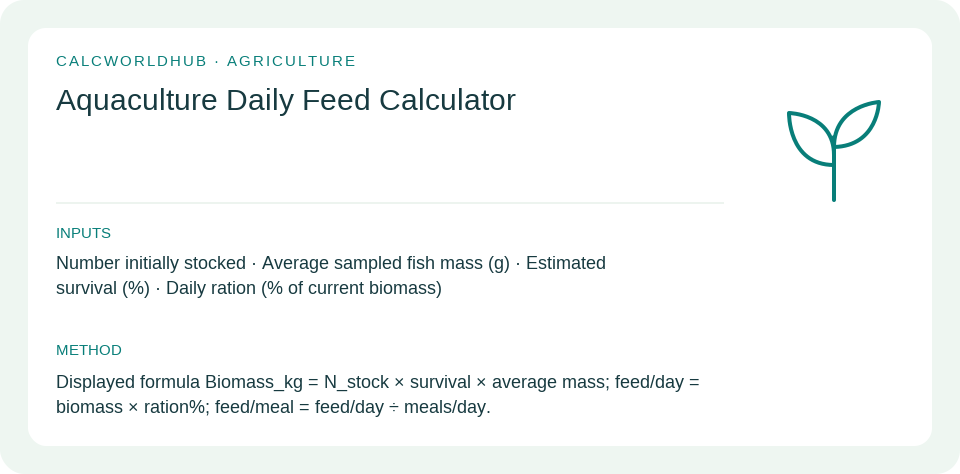
- Enter Number initially stocked, Average sampled fish mass (g), Estimated survival (%), Daily ration (% of current biomass), then complete the remaining labeled fields. Match the units shown beside each field and review the result together with the assumptions below.
- Read the worked example below to check the expected input format and result.
- Compare another scenario by changing one input at a time. Use Reset to return to the starting values.
How this calculation works
Farmed-fish feed is commonly planned as a selected percentage of estimated standing biomass per day. Estimate live biomass from the number initially stocked, average sampled weight, and survival; apply the feeding rate selected for the species, size, feed, and water conditions. The daily ration can then be divided across the entered number of meals.
Inputs and units
stockedCount— Number initially stocked- Enter the count for the pond, tank, or cage being estimated; use a whole number.
averageMassG— Average sampled fish mass (g)- Use a representative current sample, not the original stocking mass.
survivalPct— Estimated survival (%)- Enter the estimated fraction still present as a percentage from 0 to 100.
rationPct— Daily ration (% of current biomass)- Enter the species- and condition-specific daily rate you intend to evaluate.
mealsPerDay— Feeding events per day- Enter a whole number; the tool divides the daily ration evenly across events.
Formula
Biomass_kg = N_stock × survival × average mass; feed/day = biomass × ration%; feed/meal = feed/day ÷ meals/day.
Method
Multiply initial stock count by survival fraction and mean individual mass in grams, then divide by 1,000 to get biomass in kilograms. Multiply by the user-entered daily ration percentage and divide evenly by meals per day.
Worked example
For 10,000 stocked fish at 12 g average mass, 85% survival, a user-selected 3% daily ration, and 3 meals, estimated biomass is 102 kg and feed is 3.060 kg/day (1.020 kg per event).
Assumptions and limits
The tool does not prescribe a feeding rate. Appropriate rates change with species, fish size, water temperature, feed, appetite, water quality, and survival; use current species and feed guidance and adjust to observed consumption.
Frequently asked questions
Does this calculator recommend a feeding rate?
No. Enter a rate from current species- and size-specific guidance, feed instructions, and observed water and feeding conditions.
Why include survival?
Current biomass depends on the animals still present, not only the original count stocked.
Are the meal amounts always equal?
The estimate divides the daily ration evenly; actual schedules can vary by species, life stage, temperature, and farm practice.
How do I use the Aquaculture Daily Feed Calculator?
Enter Number initially stocked, Average sampled fish mass (g), Estimated survival (%), Daily ration (% of current biomass), then complete the remaining labeled fields. Match the units shown beside each field and review the result together with the assumptions below.
What is a worked example of Aquaculture Daily Feed?
For 10,000 stocked fish at 12 g average mass, 85% survival, a user-selected 3% daily ration, and 3 meals, estimated biomass is 102 kg and feed is 3.060 kg/day (1.020 kg per event).
Reference: FAO aquaculture feeding guidance based on current biomass, measured average weight, survival, and species-specific feeding rates. See our calculation methodology.