How to use this calculator
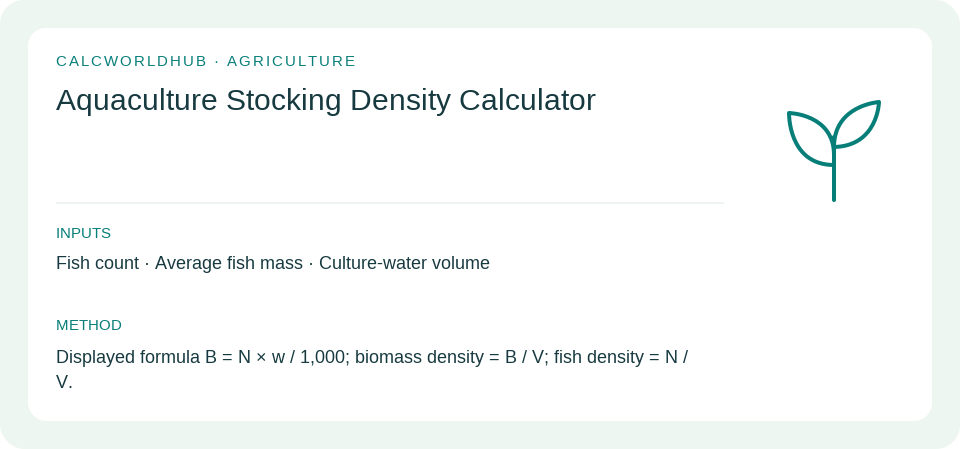
Estimate fish biomass loading per cubic metre from fish count, average mass, and culture-water volume.
- Enter Fish count, Average fish mass, Culture-water volume. Match the units shown beside each field and review the result together with the assumptions below.
- Read the worked example below to check the expected input format and result.
- Compare another scenario by changing one input at a time. Use Reset to return to the starting values.
How this calculation works
A tank or pond density is a snapshot of standing fish biomass in the water volume being managed. It helps a grower describe a stocking plan in comparable units, while leaving the biological and operational checks to the specific species and system.
Inputs and units
fishCount— Fish count- Number of fish represented by the estimate; enter a whole number.
averageMassGrams— Average fish mass- Average mass per fish in grams (g), using a representative sample.
waterVolumeM3— Culture-water volume- Water volume occupied by the culture system in cubic metres (m³). One cubic metre equals 1,000 litres.
Formula
B = N × w / 1,000; biomass density = B / V; fish density = N / V.
Method
Enter fish count N, average individual mass w in grams, and culture-water volume V in cubic metres. The calculator converts the estimated standing biomass B to kilograms, then reports kilograms of fish per cubic metre and fish per cubic metre.
Worked example
With 120 fish averaging 250 g in 3 m³ of water, estimated biomass is 120 × 250 / 1,000 = 30 kg. Biomass density is 30 / 3 = 10 kg/m³, and count density is 120 / 3 = 40 fish/m³.
Assumptions and limits
This is a unit conversion and loading estimate, not a safe stocking recommendation. Appropriate density depends on species, fish size, water exchange, dissolved oxygen, temperature, feed, filtration, and water quality. Use measured biomass and system-specific husbandry guidance when making operating decisions.
Frequently asked questions
What is biomass stocking density?
It is the total live mass of fish divided by the culture-water volume, commonly reported as kilograms per cubic metre.
Does the result tell me how many fish are safe to keep?
No. The same kg/m³ can behave differently across species, sizes, water exchange, oxygenation, filtration, feed, and temperature. Treat this as a descriptive estimate, not an operating limit.
Should I use tank capacity or actual water volume?
Use the water volume the fish occupy, not the tank's outside dimensions or empty nominal capacity. Subtract space displaced by equipment or use a measured filled volume.
How often should I update the estimate?
Reweigh a representative sample as fish grow and update the count for mortality or transfers; density changes even when tank volume stays the same.
How do I use the Aquaculture Stocking Density Calculator?
Enter Fish count, Average fish mass, Culture-water volume. Match the units shown beside each field and review the result together with the assumptions below.
Reference: FAO running-water fish-culture manual on stocking density and system conditions. See our calculation methodology.