How to use this calculator
Compare total work content with installed station time and show the theoretical minimum station count.
- Enter Task times per unit (seconds), Target station cycle time (seconds), Installed workstations. Match the units shown beside each field and review the result together with the assumptions below.
- Read the worked example below to check the expected input format and result.
- Compare another scenario by changing one input at a time. Use Reset to return to the starting values.
Assembly line balance efficiency explained
How the calculation works
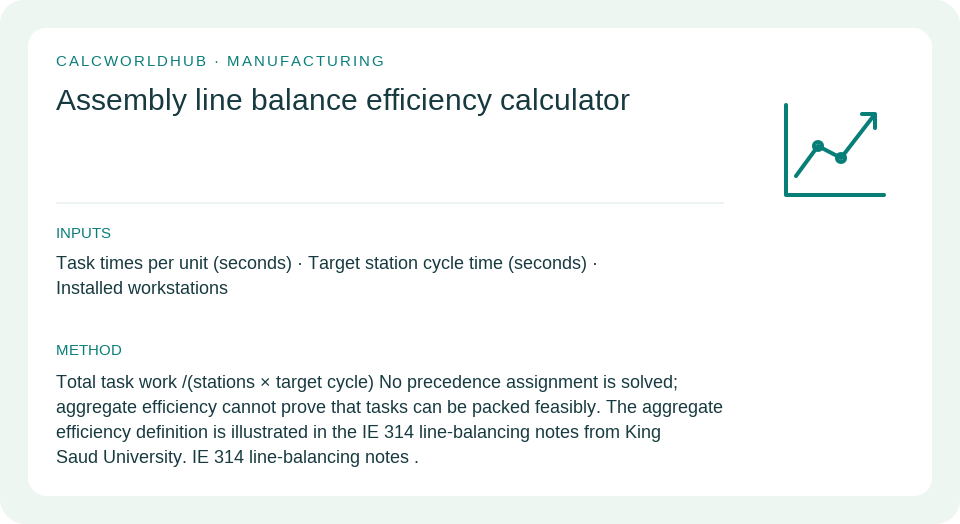
Total task work /(stations × target cycle)
No precedence assignment is solved; aggregate efficiency cannot prove that tasks can be packed feasibly.
The aggregate efficiency definition is illustrated in the IE 314 line-balancing notes from King Saud University. IE 314 line-balancing notes.
Set up the calculation
t— Task times per unit (seconds)- One processing time per task, listed in the same order as the task set; these times are summed as total work content.
c— Target station cycle time (seconds)- Maximum available time per workstation cycle, in seconds per unit.
n— Installed workstations- Number of workstations installed. This is used for aggregate efficiency, not task assignment.
Limits of this model
No precedence assignment is solved; aggregate efficiency cannot prove that tasks can be packed feasibly.
Check this example
Task times per unit (seconds) = 20, 30, 25, 15; Target station cycle time (seconds) = 40; Installed workstations = 3.
- Aggregate balance efficiency: 75 %
- Theoretical minimum stations: 3
- Idle station time per cycle: 30 seconds
- Longest-task feasibility: Pass necessary task-size check
Interpreting the result
A 75% aggregate balance means listed task work uses three quarters of the installed station-cycle capacity. The remaining time is theoretical idle capacity; it does not prove that task precedence and indivisibility allow a feasible assignment.
Frequently asked questions
Does the minimum station count guarantee a feasible balance?
No, precedence and indivisible tasks can require more.
What if one task exceeds cycle time?
The target is infeasible without splitting or parallel work.
Are idle seconds included?
The result shows total available time minus work content.
How do I use the Assembly line balance efficiency calculator?
Enter Task times per unit (seconds), Target station cycle time (seconds), Installed workstations. Match the units shown beside each field and review the result together with the assumptions below.
What is a worked example of Assembly line balance efficiency?
Task times per unit (seconds) = 20, 30, 25, 15; Target station cycle time (seconds) = 40; Installed workstations = 3. Aggregate balance efficiency: 75 % Theoretical minimum stations: 3 Idle station time per cycle: 30 seconds Longest-task feasibility: Pass necessary task-size check
Read our calculation methodology.