How to use this calculator
Find the throughput ceiling of serial stations with parallel identical machines at each station.
- Enter Cycle times per machine (seconds/unit), Parallel machines at each station, Available production hours/day, Common uptime fraction. Match the units shown beside each field and review the result together with the assumptions below.
- Read the worked example below to check the expected input format and result.
- Compare another scenario by changing one input at a time. Use Reset to return to the starting values.
Serial production line bottleneck capacity explained
Every station in a serial line must process the same throughput. Calculate each station’s daily capacity from its cycle time, parallel machine count and available operating time; the smallest capacity sets this ideal line’s ceiling.
Inputs, symbols, and units
t— Cycle times per machine (seconds/unit)- Positive seconds per unit for one machine at each station, in serial station order.
m— Parallel machines at each station- Positive integer count of identical parallel machines at each matching station.
hday— Available production hours/day- Scheduled operating hours per day for every modeled station.
u— Common uptime fraction- Available fraction of scheduled time, entered as a decimal from zero through one.
Formula and method
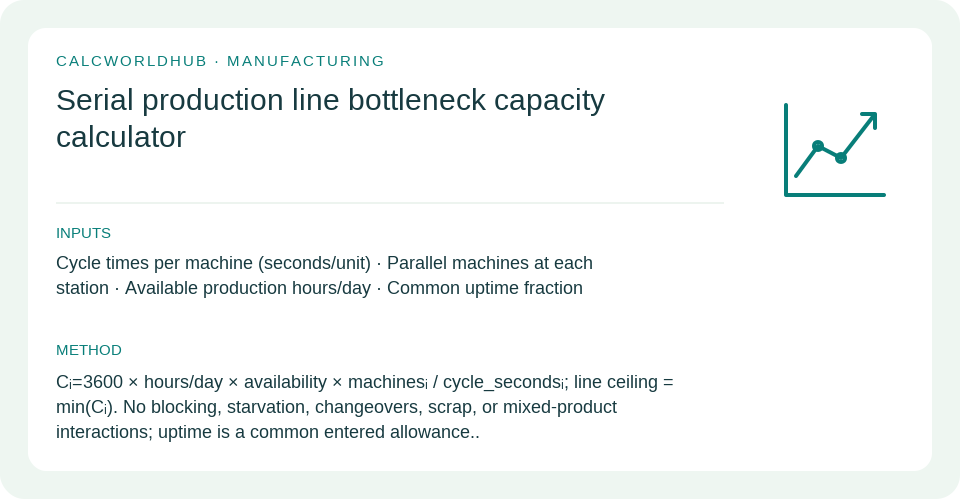
Cᵢ=3600 × hours/day × availability × machinesᵢ / cycle_secondsᵢ; line ceiling = min(Cᵢ).
No blocking, starvation, changeovers, scrap, or mixed-product interactions; uptime is a common entered allowance..
A worked scenario
Cycle times per machine (seconds/unit) = 30, 45, 20; Parallel machines at each station = 1, 2, 1; Available production hours/day = 8; Common uptime fraction = 0.9.
- Line capacity ceiling: 864 units/day
- Bottleneck station numbers: 1
The three station capacities are 8×3600×0.9×1/30=864, 8×3600×0.9×2/45=1152, and 8×3600×0.9×1/20=1296 units/day. Station 1 limits the ideal serial line to 864 units/day.
Assumptions and edge cases
No blocking, starvation, changeovers, scrap, or mixed-product interactions; uptime is a common entered allowance.
Frequently asked questions
Why use the minimum station capacity?
Every unit must pass every station.
Can parallel machines differ?
This model treats machines within one station as identical.
Does the answer guarantee output?
No, it is a simplified capacity ceiling.
How do I use the Serial production line bottleneck capacity calculator?
Enter Cycle times per machine (seconds/unit), Parallel machines at each station, Available production hours/day, Common uptime fraction. Match the units shown beside each field and review the result together with the assumptions below.
What is a worked example of Serial production line bottleneck capacity?
Cycle times per machine (seconds/unit) = 30, 45, 20; Parallel machines at each station = 1, 2, 1; Available production hours/day = 8; Common uptime fraction = 0.9. Line capacity ceiling: 864 units/day Bottleneck station numbers: 1 The three station capacities are 8×3600×0.9×1/30=864, 8×3600×0.9×2/45=1152, and 8×3600×0.9×1/20=1296 units/day. Station 1 limits the ideal serial line to 864 units/day.
Read our calculation methodology.