Astronomical flux ratio relative to 10 parsecs calculator
See how source flux changes with distance relative to the 10 pc reference.
Calculator
How to use this calculator
Compare inverse-square source flux at a positive distance with the flux at 10 parsecs.
- Enter Distance from source (parsecs). Match the units shown beside each field and review the result together with the assumptions below.
- Read the worked example below to check the expected input format and result.
- Compare another scenario by changing one input at a time. Use Reset to return to the starting values.
Compare source flux with its value at 10 parsecs
For the same steady source in unobstructed space, received flux follows an inverse-square distance relation. This calculator compares flux at an entered distance with flux at 10 parsecs.
Inputs and units
- Distance from source (parsecs): Enter a positive distance measured from the source; the reference distance is fixed at 10 pc.
Formula and method
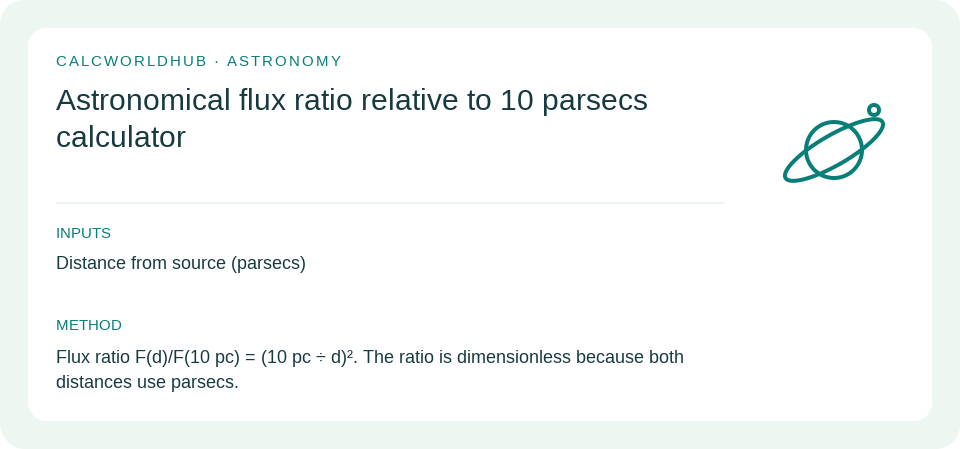
Flux ratio F(d)/F(10 pc) = (10 pc ÷ d)². The ratio is dimensionless because both distances use parsecs.
Worked example
At d = 40 pc, the ratio is (10/40)² = 1/16 = 0.0625. The source’s flux there is 6.25% of the flux at 10 pc.
Interpreting the result
A result below 1 means the source appears fainter at the entered distance than at 10 pc. Doubling distance divides flux by four under this model.
Assumptions and limits
This idealizes the source as unchanged and ignores extinction, scattering, intervening material, variability, and detector response. It is not an apparent-to-absolute-magnitude conversion.
Method references
Frequently asked questions
Why is the distance squared?
Light from an isotropic source spreads over spherical areas that grow with the square of radius.
What does 0.0625 mean?
It is a fraction: 0.0625 of the 10 pc flux, or 6.25%.
How do I use the Astronomical flux ratio relative to 10 parsecs calculator?
Enter Distance from source (parsecs). Match the units shown beside each field and review the result together with the assumptions below.
What is a worked example of Astronomical flux ratio relative to 10 parsecs?
At d = 40 pc, the ratio is (10/40)² = 1/16 = 0.0625. The source’s flux there is 6.25% of the flux at 10 pc.
What does the Astronomical flux ratio relative to 10 parsecs calculator calculate?
Compare inverse-square source flux at a positive distance with the flux at 10 parsecs.
Good calculators show their work.
CalcWorldHub is built around clear inputs and visible assumptions. Results are estimates for planning; check official sources or your provider’s terms when exact figures matter.