How to use this calculator
Enforce separate rising and falling command-rate limits on a sampled actuator.
- Enter Previous output, Requested output, Maximum upward rate (units/s), Maximum downward rate (units/s), then complete the remaining labeled fields. Match the units shown beside each field and review the result together with the assumptions below.
- Read the worked example below to check the expected input format and result.
- Compare another scenario by changing one input at a time. Use Reset to return to the starting values.
Asymmetric actuator slew limiter explained
The limiter compares the requested change with separate upward and downward rate bounds over the update interval. It returns the reachable command for this step, which can become the previous output for the next update.
Inputs, symbols, and units
previous— Previous output- Last actual actuator command.
target— Requested output- Unconstrained new command.
up— Maximum upward rate (units/s)- Positive command increase limit.
down— Maximum downward rate (units/s)- Positive magnitude of command decrease limit.
dt— Update interval (s)- Time available to change the command.
Formula and method
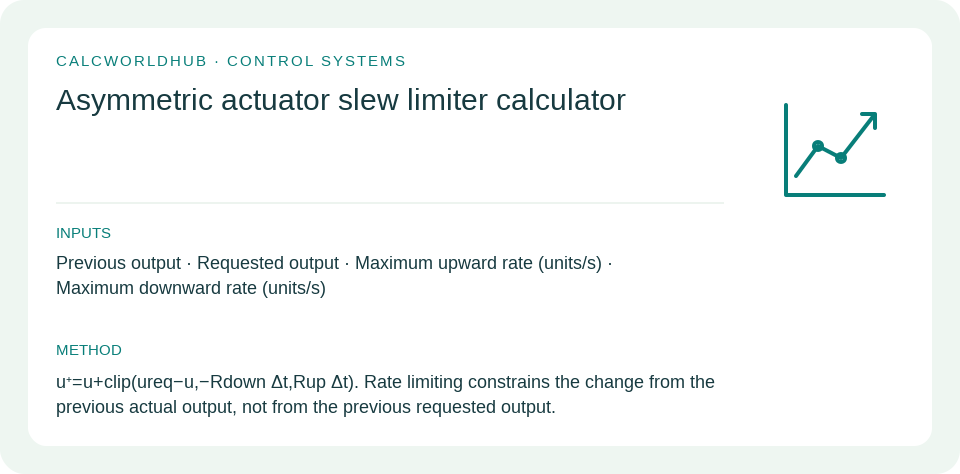
u⁺=u+clip(ureq−u,−Rdown Δt,Rup Δt).
Rate limiting constrains the change from the previous actual output, not from the previous requested output.
A worked scenario
Previous output = 2; Requested output = 5; Maximum upward rate (units/s) = 4; Maximum downward rate (units/s) = 2; Update interval (s) = 0.2.
- Limited output: 2.8 actuator units
- Actual slew rate: 4 units/s
- Remaining command gap: 2.2 actuator units
A command rises from two toward five over 0.2 seconds; the upward rate cap permits only a 0.8-unit step.
Assumptions and edge cases
No absolute amplitude saturation or acceleration-of-command limit is included.
Reading the outputs
The remaining gap shows unachieved demand; actual slew is the realized command change divided by the interval.
Frequently asked questions
Can a rate be zero?
Yes; movement in that direction is then blocked.
What state must I retain?
Retain the returned limited output for the next update.
Does this limit physical motor speed?
It limits the command; the actuator dynamics determine physical response.
How do I use the Asymmetric actuator slew limiter calculator?
Enter Previous output, Requested output, Maximum upward rate (units/s), Maximum downward rate (units/s), then complete the remaining labeled fields. Match the units shown beside each field and review the result together with the assumptions below.
What is a worked example of Asymmetric actuator slew limiter?
Previous output = 2; Requested output = 5; Maximum upward rate (units/s) = 4; Maximum downward rate (units/s) = 2; Update interval (s) = 0.2. Limited output: 2.8 actuator units Actual slew rate: 4 units/s Remaining command gap: 2.2 actuator units A command rises from two toward five over 0.2 seconds; the upward rate cap permits only a 0.8-unit step.
Read our calculation methodology.