How to use this calculator
Model a held-actuator tracking response for a PID integral contribution and its equilibrium.
- Enter Initial integral contribution, Held proportional contribution, Held derivative contribution, Actual tracked actuator output, then complete the remaining labeled fields. Match the units shown beside each field and review the result together with the assumptions below.
- Read the worked example below to check the expected input format and result.
- Compare another scenario by changing one input at a time. Use Reset to return to the starting values.
Model an integrator state tracking a held actuator output
This response model shows how a PI or PID controller’s integral contribution moves toward a tracking equilibrium while the actuator output, proportional term, derivative term, and control error are held constant.
Inputs and units
- Initial integral contribution: Integral state at the start of tracking, in actuator-output units.
- Held proportional contribution: Constant proportional contribution during the tracking interval.
- Held derivative contribution: Constant, already scaled derivative contribution.
- Actual tracked actuator output: Actuator or selected output that the controller tracks.
- Integral gain (actuator/error/s): Integral gain used in the tracking-equilibrium term.
- Held control error: Constant error value during the interval.
- Tracking time constant (s): Positive time constant governing how fast the integral contribution approaches equilibrium.
- Elapsed tracking time (s): Nonnegative time since tracking began.
Formula and method
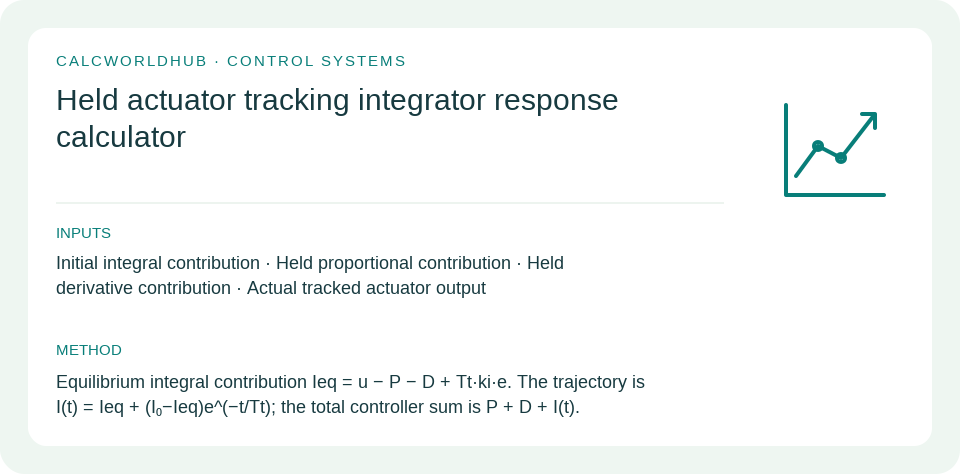
Equilibrium integral contribution Ieq = u − P − D + Tt·ki·e. The trajectory is I(t) = Ieq + (I₀−Ieq)e^(−t/Tt); the total controller sum is P + D + I(t).
Worked example
With I₀=3, P=4, D=0, u=5, ki=0.5, e=2, Tt=0.4 s, and t=0.1 s, Ieq=1.4. Then I(t)=1.4+(3−1.4)e^(−0.25)=2.646081 actuator units.
Interpreting the result
The integral contribution has moved from 3 toward the 1.4-unit tracking equilibrium but has not reached it after 0.1 s. The third output adds the held P and D terms to show the controller sum.
Assumptions and limits
Assumes all listed signals except the integral state remain fixed and the tracking dynamics are first order. It is not a full closed-loop simulation and does not model actuator saturation dynamics or controller implementation details.
Method references
Frequently asked questions
What happens after several tracking time constants?
The exponential term decays toward zero, so the integral contribution approaches its tracking equilibrium. One time constant leaves about 36.8% of the initial difference.
How do I use the Held actuator tracking integrator response calculator?
Enter Initial integral contribution, Held proportional contribution, Held derivative contribution, Actual tracked actuator output, then complete the remaining labeled fields. Match the units shown beside each field and review the result together with the assumptions below.
What is a worked example of Held actuator tracking integrator response?
With I₀=3, P=4, D=0, u=5, ki=0.5, e=2, Tt=0.4 s, and t=0.1 s, Ieq=1.4. Then I(t)=1.4+(3−1.4)e^(−0.25)=2.646081 actuator units.
What does the Held actuator tracking integrator response calculator calculate?
Model a held-actuator tracking response for a PID integral contribution and its equilibrium.
What assumptions apply to Held actuator tracking integrator response?
Assumes all listed signals except the integral state remain fixed and the tracking dynamics are first order. It is not a full closed-loop simulation and does not model actuator saturation dynamics or controller implementation details.