At least one success probability calculator
inputs.
Related calculators and articles
Compare methods and explore more free tools in probability.
How to use this calculator
Find the chance of one or more successes across independent repeated trials.
- Enter Success chance per trial (%), Number of independent trials. Match the units shown beside each field and review the result together with the assumptions below.
- Read the worked example below to check the expected input format and result.
- Compare another scenario by changing one input at a time. Use Reset to return to the starting values.
At least one success probability
Estimate the probability of one or more successes across repeated trials with the same per-trial chance.
What this calculator measures
The calculation subtracts the chance of zero successes from 100%. A 40.951% result means at least one success across five trials with 10% chance each; it is not the expected number of successes.
Inputs and units
Enter the chance for one trial as a percentage and the number of comparable independent trials as a whole-number count. The probability is converted to a decimal inside the formula.
- Success chance per trial (%): Enter a percentage in the format shown; do not switch between a whole percent and a decimal fraction.
- Number of independent trials: Count repeats with the same chance model. Zero is allowed and means no trial can succeed.
Formula and method
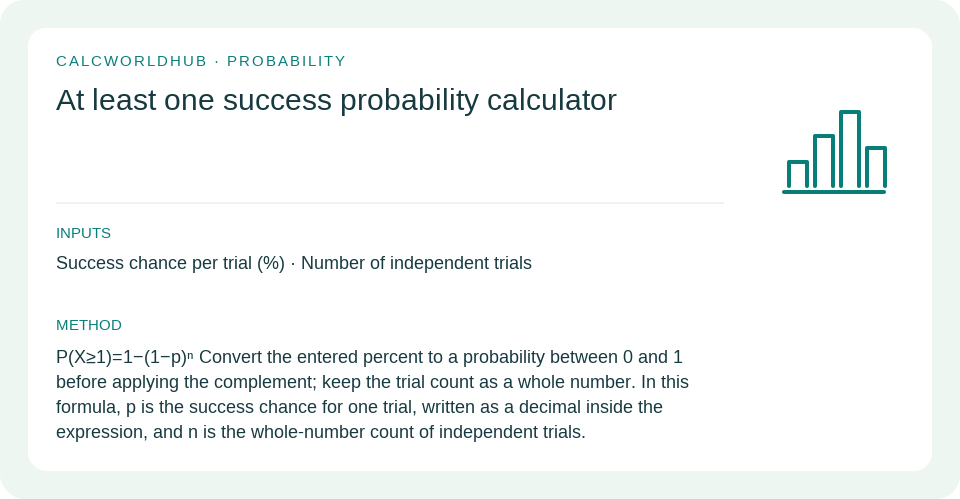
P(X≥1)=1−(1−p)ⁿ
Convert the entered percent to a probability between 0 and 1 before applying the complement; keep the trial count as a whole number.
In this formula, p is the success chance for one trial, written as a decimal inside the expression, and n is the whole-number count of independent trials.
Using the result
- Enter p from 0% through 100% and n as a whole-number count.
- The output is the chance of one or more successes, including two or more.
- For exactly one success, use a binomial exact-outcome calculation.
Worked example
Suppose each trial has a 10% chance of success and there are 5 independent trials. The chance of no successes is 0.90⁵ = 0.59049. Subtracting from 1 gives 1 − 0.59049 = 0.40951, or 40.951% for at least one success. This is different from the probability of exactly one success.
For this example, the calculator inputs are 10 in “Success chance per trial (%)” and 5 in “Number of independent trials.”
Interpreting the result
The result is a percentage chance of at least one success, including outcomes with two or more successes. For p=0 or n=0 it is 0%; for p=100% and n>0 it is 100%.
Assumptions and limits
Use a success probability from 0% through 100% and a whole-number trial count. The formula assumes the same chance on every independent trial. With zero trials or p=0 the result is 0%; with p=100% and at least one trial it is 100%. If one outcome changes the next trial’s chance, this model does not apply.
Frequently asked questions
Does this calculate exactly one success?
No. It includes every outcome with one or more successes; the chance of exactly one is a different binomial probability.
What if there are no trials or no chance of success?
The probability of at least one success is 0% in either case.
Must the trials be independent?
Yes. The formula assumes the same success chance on each trial and that one trial does not affect another.
How do I use the At least one success probability calculator?
Enter Success chance per trial (%), Number of independent trials. Match the units shown beside each field and review the result together with the assumptions below.
What is a worked example of At least one success probability?
Suppose each trial has a 10% chance of success and there are 5 independent trials. The chance of no successes is 0.90⁵ = 0.59049. Subtracting from 1 gives 1 − 0.59049 = 0.40951, or 40.951% for at least one success. This is different from the probability of exactly one success. For this example, the calculator inputs are 10 in “Success chance per trial (%)” and 5 in “Number of independent trials.”
Read the calculation methodology and privacy policy.