Independent events union probability calculator
Find the probability that either of two independent events occurs, accounting for their overlap instead of adding probabilities directly.
inputs.
How to use this calculator
Find the probability that either of two independent events occurs, accounting for their overlap instead of adding probabilities directly.
- Enter Event A chance (%), Event B chance (%). Match the units shown beside each field and review the result together with the assumptions below.
- Read the worked example below to check the expected input format and result.
- Compare another scenario by changing one input at a time. Use Reset to return to the starting values.
How the Independent events union probability calculator works
Find the probability that either of two independent events occurs, accounting for their overlap instead of adding probabilities directly.
Inputs and units
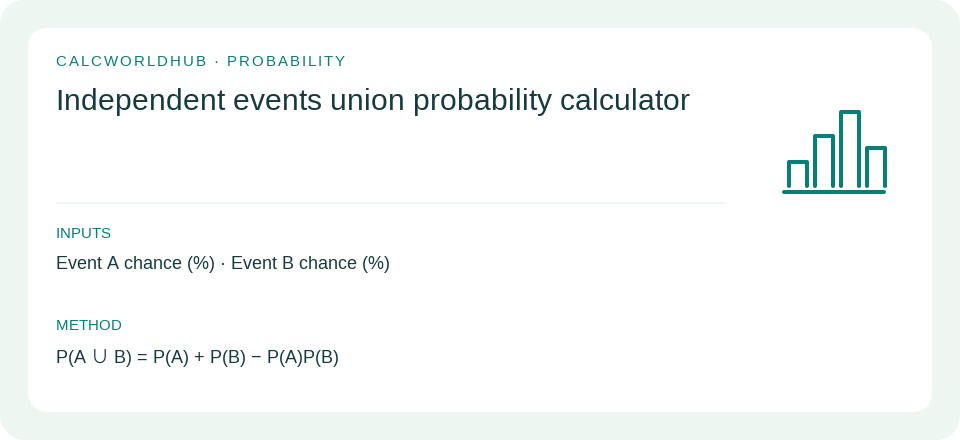
- Event A chance (%): Probability of event A as a percentage.
- Event B chance (%): Probability of event B as a percentage, assumed independent of A.
Formula and method
P(A ∪ B) = P(A) + P(B) − P(A)P(B)
Worked example
At 40% and 25%, independence gives a 10% overlap: 40% + 25% − 10% = 55%.
Interpreting the result
The union includes outcomes where both events occur. It is not an exclusive-or probability.
Assumptions and limits
Both percentages must be from 0 to 100. Independence is an assumption; for dependent events, enter an independently known overlap in a general union calculation.
Sources and method
- Explains independence, conditional probabilities, and Bayes updating. OpenStax Principles of Data Science: probability theory
Frequently asked questions
Why subtract an overlap?
Adding P(A) and P(B) counts outcomes where both occur twice. For independent events, their overlap is P(A)P(B).
Can I use this for mutually exclusive events?
Generally no. Positive-probability mutually exclusive events are not independent.
How do I use the Independent events union probability calculator?
Enter Event A chance (%), Event B chance (%). Match the units shown beside each field and review the result together with the assumptions below.
What is a worked example of Independent events union probability?
At 40% and 25%, independence gives a 10% overlap: 40% + 25% − 10% = 55%.
What does the Independent events union probability calculator calculate?
Find the probability that either of two independent events occurs, accounting for their overlap instead of adding probabilities directly.
See the calculation methodology.