Conditional probability calculator
Find the probability of A among cases where B occurs, using the joint probability and the probability of B.
inputs.
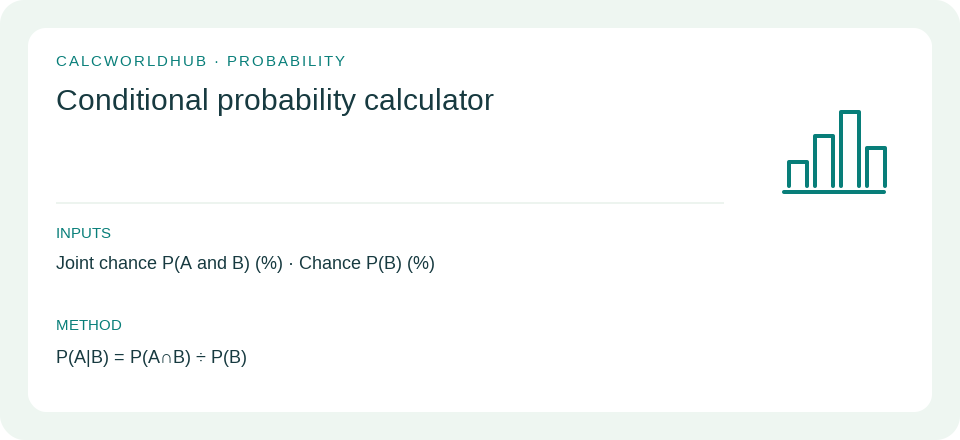
How to use this calculator
Find the probability of A among cases where B occurs, using the joint probability and the probability of B.
- Enter Joint chance P(A and B) (%), Chance P(B) (%). Match the units shown beside each field and review the result together with the assumptions below.
- Read the worked example below to check the expected input format and result.
- Compare another scenario by changing one input at a time. Use Reset to return to the starting values.
How the Conditional probability calculator works
Find the probability of A among cases where B occurs, using the joint probability and the probability of B.
Inputs and units
- Joint chance P(A and B) (%): Joint event probability P(A and B), entered as a percentage.
- Chance P(B) (%): Conditioning event probability P(B), entered as a positive percentage at least as large as the joint probability.
Formula and method
P(A|B) = P(A∩B) ÷ P(B)
Worked example
If P(A and B)=12% and P(B)=30%, then P(A|B)=12/30=0.40, or 40%.
Interpreting the result
The result is a conditional probability: the reference group is the cases where B happened. It is not the probability of B or the joint probability itself.
Assumptions and limits
Use probabilities on the same population and event definitions. P(B) must be positive, and the joint probability cannot exceed P(B). Percent inputs are divided as percentages in the ratio.
Sources and method
- Defines conditional probability as the joint probability divided by the conditioning-event probability. OpenStax Introductory Statistics 2e: probability rules
Frequently asked questions
Why can the conditional probability differ from the joint probability?
Conditioning restricts the denominator to the B cases, so the joint share is rescaled within that subset.
Can the joint chance be larger than P(B)?
No. A∩B is a subset of B; such inputs are inconsistent with the event definitions.
How do I use the Conditional probability calculator?
Enter Joint chance P(A and B) (%), Chance P(B) (%). Match the units shown beside each field and review the result together with the assumptions below.
What is a worked example of Conditional probability?
If P(A and B)=12% and P(B)=30%, then P(A|B)=12/30=0.40, or 40%.
What does the Conditional probability calculator calculate?
Find the probability of A among cases where B occurs, using the joint probability and the probability of B.
See the calculation methodology.