How to use this calculator
Estimate in-place excavation volume between two surveyed cut cross-sections using the average end-area method.
- Enter Cut area at first section A₁ (m²), Cut area at next section A₂ (m²), Horizontal spacing between sections (m), Cut swell allowance (%). Match the units shown beside each field and review the result together with the assumptions below.
- Read the worked example below to check the expected input format and result.
- Compare another scenario by changing one input at a time. Use Reset to return to the starting values.
How this calculation works
For adjacent cross-sections, the average end-area method treats the interval as a prism whose end area is the mean of the two measured sections. The calculator reports bank volume and a separate loose-cut estimate after an entered swell allowance; the allowance does not change the in-place volume.
Inputs and units
area1— Cut area at first section A₁ (m²)- Measured excavation area at the first station.
area2— Cut area at next section A₂ (m²)- Measured excavation area at the next station.
length— Horizontal spacing between sections (m)- Station distance between the two cross-sections.
swell— Cut swell allowance (%)- Optional volume expansion after excavation; enter zero for bank volume only.
Formula
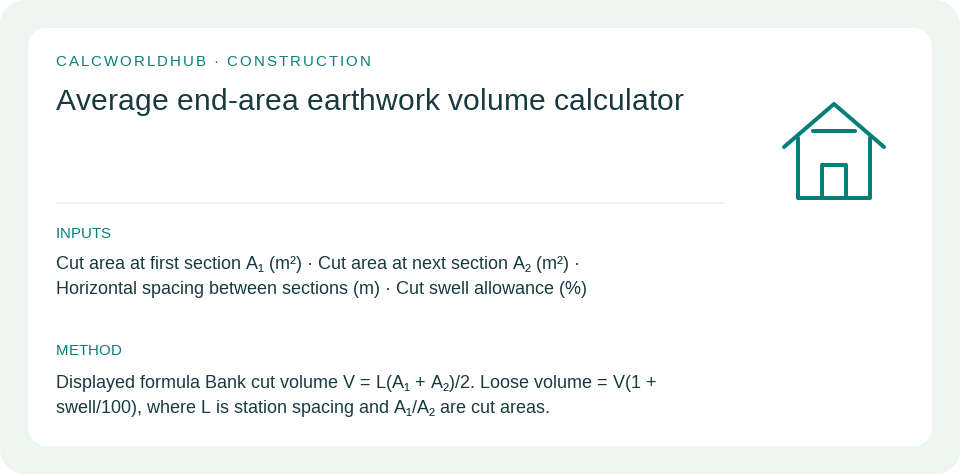
Bank cut volume V = L(A₁ + A₂)/2. Loose volume = V(1 + swell/100), where L is station spacing and A₁/A₂ are cut areas.
Method
Enter cut cross-sectional areas in square metres, the horizontal station interval in metres, and an optional swell percentage for a loose excavation estimate. Use separate intervals and sum their volumes for a multi-section corridor.
Worked example
With cut areas of 12 m² and 18 m² spaced 30 m apart, bank volume is 30 × (12+18)/2 = 450 m³. A 15% swell assumption gives 517.5 m³ loose volume.
Assumptions and limits
The average end-area method approximates the volume between sampled sections; irregular terrain, abrupt transitions, mixed cut/fill, unsuitable material, and shrinkage require separate treatment. The swell percentage is a user assumption, not a material property supplied by this calculator.
Frequently asked questions
What is the average end-area method?
It multiplies the mean of two neighboring cross-section areas by the distance between those sections.
Is loose volume the same as compacted fill volume?
No. Swell estimates excavation expansion; compacted fill needs a separate shrinkage or compaction factor.
Can I combine cut and fill in one area?
No. Calculate cut and fill separately for each interval because their quantities and conversion factors differ.
How do I handle more than two stations?
Calculate each adjacent interval and sum the interval volumes, keeping station order and units consistent.
How do I use the Average end-area earthwork volume calculator?
Enter Cut area at first section A₁ (m²), Cut area at next section A₂ (m²), Horizontal spacing between sections (m), Cut swell allowance (%). Match the units shown beside each field and review the result together with the assumptions below.
Reference: FHWA Earthwork Design guidance on average end area. See our calculation methodology.