How to use this calculator
Compare the projected cost of keeping a card balance with transferring it to a promotional-rate offer.
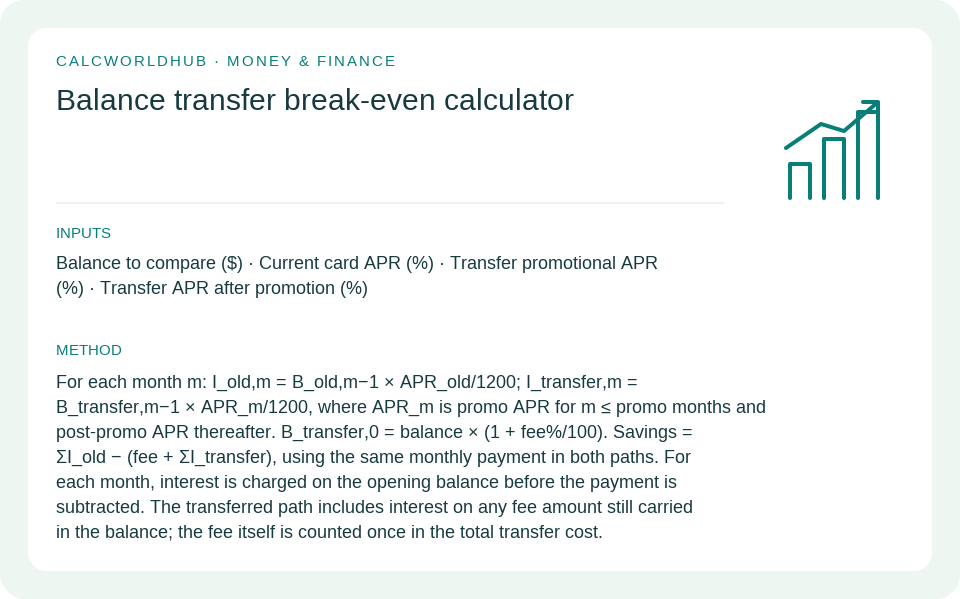
- Enter Balance to compare ($), Current card APR (%), Transfer promotional APR (%), Transfer APR after promotion (%), then complete the remaining labeled fields. Match the units shown beside each field and review the result together with the assumptions below.
- Read the worked example below to check the expected input format and result.
- Compare another scenario by changing one input at a time. Use Reset to return to the starting values.
How this estimate works
This comparison simulates two declining balances month by month: the current card keeps its APR, while the transfer balance starts with the fee added and uses the promotional APR before switching to the post-promotion rate. Both paths receive the same fixed monthly payment.
Inputs and units
balance— Balance to compare ($)- Enter the amount being considered for transfer.
oldApr— Current card APR (%)- APR if the balance stays on the current card.
promoApr— Transfer promotional APR (%)- APR during the introductory period.
postApr— Transfer APR after promotion (%)- APR after the promotion ends.
promoMonths— Promotional period (months)- Number of months at the promotional APR.
feePct— Transfer fee (%)- One-time fee added to the transferred balance.
payment— Monthly payment ($)- Use the same planned payment in both scenarios.
Formula and method
For each month m: I_old,m = B_old,m−1 × APR_old/1200; I_transfer,m = B_transfer,m−1 × APR_m/1200, where APR_m is promo APR for m ≤ promo months and post-promo APR thereafter. B_transfer,0 = balance × (1 + fee%/100). Savings = ΣI_old − (fee + ΣI_transfer), using the same monthly payment in both paths.
For each month, interest is charged on the opening balance before the payment is subtracted. The transferred path includes interest on any fee amount still carried in the balance; the fee itself is counted once in the total transfer cost.
Worked example
At $5,000, 24% current APR, 0% for 12 months after transfer, a 3% fee, and $500 monthly payments, the current-card path accrues about $635.16 in interest. The transfer path costs $150 in fee plus interest, a modeled $485.16 less under these assumptions. A smaller payment or shorter promotion could leave balance accruing the post-promo APR.
Assumptions and limits
This is a simplified comparison, not an offer approval or recommendation. It assumes the promotional rate applies to the full transferred balance, no new charges or late-payment repricing, and a fixed monthly payment that clears both paths.
Frequently asked questions
How is the transfer fee treated?
The fee is added to the transferred starting balance, so it is paid down with the balance.
What if the promotional APR ends before payoff?
The model switches to the post-promotion APR after the entered number of months.
Does this include annual fees or missed-payment penalties?
No. Add those separately when comparing real card offers.
How do I use the Balance transfer break-even calculator?
Enter Balance to compare ($), Current card APR (%), Transfer promotional APR (%), Transfer APR after promotion (%), then complete the remaining labeled fields. Match the units shown beside each field and review the result together with the assumptions below.
What is a worked example of Balance transfer break-even?
At $5,000, 24% current APR, 0% for 12 months after transfer, a 3% fee, and $500 monthly payments, the current-card path accrues about $635.16 in interest. The transfer path costs $150 in fee plus interest, a modeled $485.16 less under these assumptions. A smaller payment or shorter promotion could leave balance accruing the post-promo APR.
Read our calculation methodology.