How to use this calculator
Calculate the share of a revolving credit limit currently used, from the reported balance and total limit.
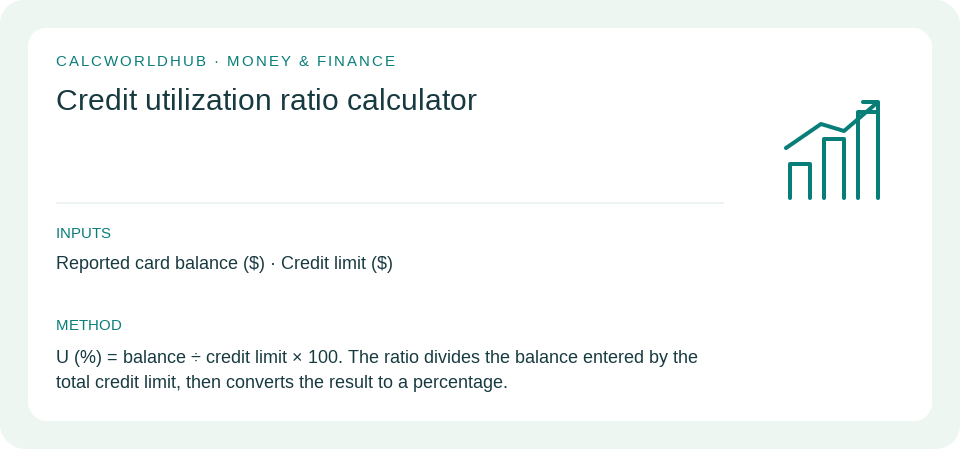
- Enter Reported card balance ($), Credit limit ($). Match the units shown beside each field and review the result together with the assumptions below.
- Read the worked example below to check the expected input format and result.
- Compare another scenario by changing one input at a time. Use Reset to return to the starting values.
How this estimate works
The utilization percentage is a snapshot of revolving balance relative to its credit line. The result changes as either reported balance or limit changes.
Inputs and units
balance— Reported card balance ($)- Use the balance that is likely to be reported for this account.
limit— Credit limit ($)- Enter the credit line for the same account.
Formula and method
U (%) = balance ÷ credit limit × 100.
The ratio divides the balance entered by the total credit limit, then converts the result to a percentage.
Worked example
A $2,450 balance on a $10,000 limit gives 2,450 ÷ 10,000 × 100 = 24.5% utilization.
Assumptions and limits
This estimates a utilization ratio from the numbers entered. Issuers may report at different times, and scoring models can consider account-level and overall utilization.
Frequently asked questions
Does this predict a credit score?
No. It reports the balance-to-limit ratio only; it does not estimate a score.
Should I use the statement balance or current balance?
Use the balance you want to evaluate. The amount an issuer reports can depend on its reporting date and account rules.
Can utilization exceed 100%?
Yes, if the balance is greater than the limit; the ratio will show that directly.
How do I use the Credit utilization ratio calculator?
Enter Reported card balance ($), Credit limit ($). Match the units shown beside each field and review the result together with the assumptions below.
What is a worked example of Credit utilization ratio?
A $2,450 balance on a $10,000 limit gives 2,450 ÷ 10,000 × 100 = 24.5% utilization.
Read our calculation methodology.