How to use this calculator
Calculate hits on balls put in play while excluding home runs and strikeouts from a matching set of batting totals.
- Enter At-bats (AB), Hits (H), Home runs (HR), Strikeouts (K), then complete the remaining labeled fields. Match the units shown beside each field and review the result together with the assumptions below.
- Read the worked example below to check the expected input format and result.
- Compare another scenario by changing one input at a time. Use Reset to return to the starting values.
How this calculation works
BABIP focuses on batting outcomes for balls put into the field of play. Enter totals from one player and one scoring period; sacrifice flies add opportunities to the denominator, while home runs and strikeouts are removed.
Inputs and units
atBats— At-bats (AB)- Official at-bats for the selected batter and period.
hits— Hits (H)- All official hits in the same period, including home runs.
homeRuns— Home runs (HR)- Home runs are hits but are excluded from balls in play.
strikeouts— Strikeouts (K)- Strikeouts remove at-bats that did not produce a ball in play.
sacrificeFlies— Sacrifice flies (SF)- Sacrifice flies add balls-in-play opportunities without adding an at-bat.
Formula
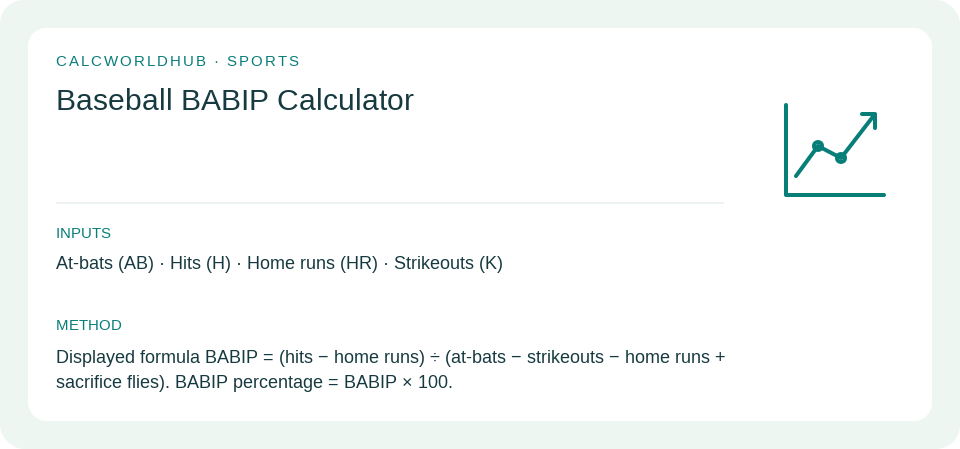
BABIP = (hits − home runs) ÷ (at-bats − strikeouts − home runs + sacrifice flies). BABIP percentage = BABIP × 100.
Method
The numerator counts non-home-run hits. The denominator estimates balls in play from at-bats, subtracting strikeouts and home runs and adding sacrifice flies, which are not counted as at-bats.
Worked example
A batter with 500 at-bats, 145 hits, 20 home runs, 100 strikeouts, and 5 sacrifice flies has (145 − 20) ÷ (500 − 100 − 20 + 5) = 125 ÷ 385 = 0.3247, or 32.47%.
Assumptions and limits
Use one scoring system and the same date range for all inputs. This calculator applies the displayed counting-stat formula; it does not adjust for scoring corrections, reached-on-error outcomes, or sample-size context.
Frequently asked questions
Are home runs included in BABIP?
No. Home runs are hits, but they are removed from both the numerator and the balls-in-play denominator.
Why are sacrifice flies added to the denominator?
A sacrifice fly can be a ball in play without being recorded as an at-bat, so the formula adds sacrifice flies back as opportunities.
Does a higher BABIP prove a batter is better?
No. BABIP describes a rate for the entered sample; it does not account for context, defense, batted-ball quality, or sample size.
Which dates should I use?
Use at-bats, hits, home runs, strikeouts, and sacrifice flies from the same player and period.
How do I use the Baseball BABIP Calculator?
Enter At-bats (AB), Hits (H), Home runs (HR), Strikeouts (K), then complete the remaining labeled fields. Match the units shown beside each field and review the result together with the assumptions below.
Reference: Major League Baseball glossary definition and BABIP formula. See our calculation methodology.