How to use this calculator
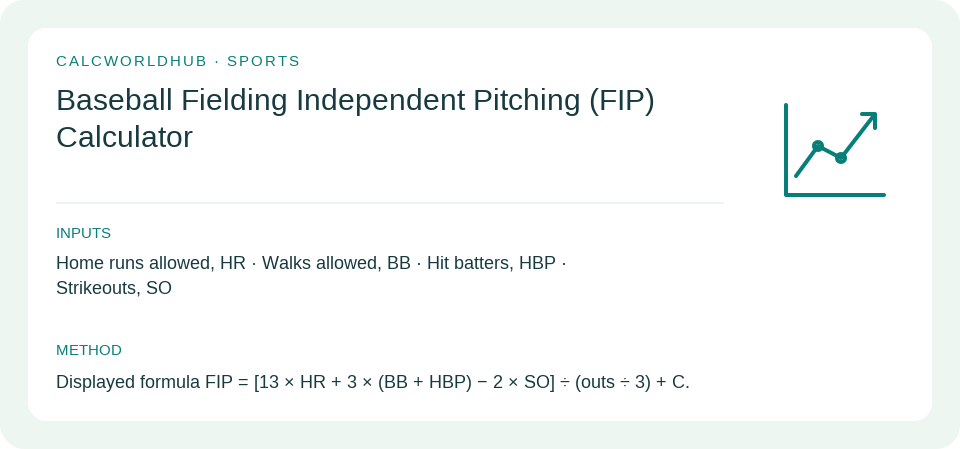
Estimate baseball FIP from home runs, walks, hit batters, strikeouts, innings, and a league constant.
- Enter Home runs allowed, HR, Walks allowed, BB, Hit batters, HBP, Strikeouts, SO, then complete the remaining labeled fields. Match the units shown beside each field and review the result together with the assumptions below.
- Read the worked example below to check the expected input format and result.
- Compare another scenario by changing one input at a time. Use Reset to return to the starting values.
How this calculation works
Fielding Independent Pitching estimates an ERA-like pitching rate from events largely attributed to the pitcher: home runs, walks, hit-by-pitches, and strikeouts. This version accepts outs recorded so partial innings are represented exactly in thirds.
Inputs and units
homeRuns— Home runs allowed, HR- Home runs allowed in the sample.
walks— Walks allowed, BB- Total walks allowed in the same sample.
hitByPitch— Hit batters, HBP- Batters hit by a pitch in the same sample.
strikeouts— Strikeouts, SO- Pitcher strikeouts in the same sample.
outsRecorded— Outs recorded- Total outs recorded while pitching; innings pitched equals outs divided by three.
fipConstant— FIP constant, C- League- and season-specific constant that aligns FIP to the ERA scale.
Formula
FIP = [13 × HR + 3 × (BB + HBP) − 2 × SO] ÷ (outs ÷ 3) + C.
Method
Convert recorded outs to innings pitched by dividing by three. Apply the traditional FIP event weights, divide by innings, and add the supplied league and season constant.
Worked example
For 1 home run, 2 walks, no hit batters, 6 strikeouts, 18 outs, and C = 3.20, IP = 6 and FIP = (13 + 6 − 12) ÷ 6 + 3.20 = 4.37.
Assumptions and limits
The FIP constant varies by league and season and must be entered for the same competition and period as the statistics. This is the traditional FIP formula; it is an estimate on an ERA-like scale and does not include balls in play.
Frequently asked questions
How do I enter a partial inning?
Enter outs recorded. Two outs in an inning add 2/3 of an inning, avoiding decimal baseball notation.
Where should I get the FIP constant?
Use the league- and season-specific value for the same sample; there is no single constant for every competition and year.
Does FIP include hits on balls in play?
No. The traditional formula uses home runs, walks, hit batters, strikeouts, innings, and a scaling constant.
How do I use the Baseball Fielding Independent Pitching (FIP) Calculator?
Enter Home runs allowed, HR, Walks allowed, BB, Hit batters, HBP, Strikeouts, SO, then complete the remaining labeled fields. Match the units shown beside each field and review the result together with the assumptions below.
What is a worked example of Baseball Fielding Independent Pitching (FIP)?
For 1 home run, 2 walks, no hit batters, 6 strikeouts, 18 outs, and C = 3.20, IP = 6 and FIP = (13 + 6 − 12) ÷ 6 + 3.20 = 4.37.
Reference: MLB.com official Fielding Independent Pitching definition and formula. See our calculation methodology.