How to use this calculator
Estimate boil-hop bitterness with the Tinseth model using hop mass, alpha acids, boil time, wort gravity, and volume.
- Enter Hop mass, Alpha acids, Boil time, Average boil specific gravity, then complete the remaining labeled fields. Match the units shown beside each field and review the result together with the assumptions below.
- Read the worked example below to check the expected input format and result.
- Compare another scenario by changing one input at a time. Use Reset to return to the starting values.
How this calculation works
A Tinseth estimate combines hop alpha-acid mass with a utilization factor that rises with boil duration and falls as wort gravity increases. It provides a consistent recipe-planning estimate for a boil addition rather than a laboratory measurement of finished beer.
Inputs and units
mass— Hop mass- Mass for this hop addition, in grams.
alpha— Alpha acids- Hop alpha-acid content printed as a percent, such as 10 for 10%.
time— Boil time- Minutes the addition boils in the wort; zero minutes gives zero Tinseth boil utilization.
gravity— Average boil specific gravity- Specific gravity of the wort during the boil, entered as a value such as 1.050.
volume— Wort volume- Volume in liters to which this hop bitterness contribution is applied.
Formula
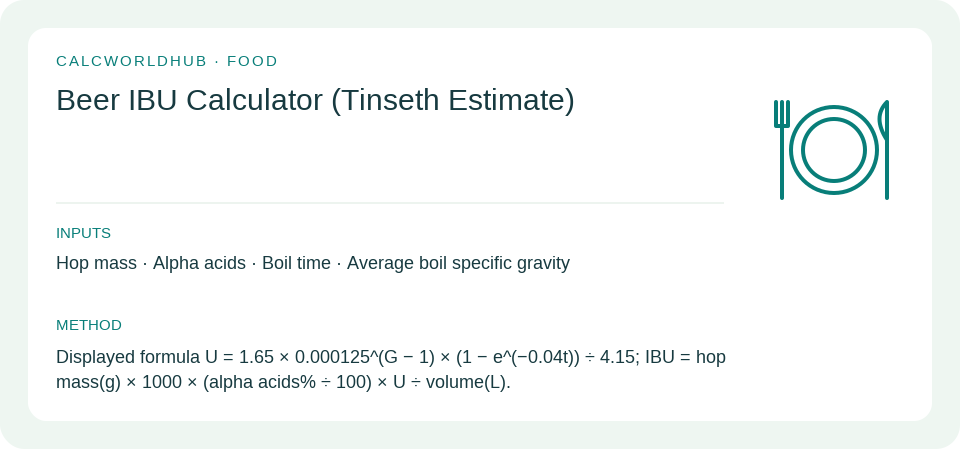
U = 1.65 × 0.000125^(G − 1) × (1 − e^(−0.04t)) ÷ 4.15; IBU = hop mass(g) × 1000 × (alpha acids% ÷ 100) × U ÷ volume(L).
Method
Enter the hop mass for one boil addition, its alpha-acid percentage, boil minutes, average boil gravity as specific gravity, and the wort volume in liters used for the estimate. The calculation uses the Tinseth utilization equation and does not add a pellet adjustment.
Worked example
For 28 g of 10% alpha-acid hops boiled 60 minutes in 20 L at an average gravity of 1.050, Tinseth utilization is about 23.07% and the estimated contribution is about 32.29 IBU.
Assumptions and limits
Tinseth is an empirical recipe estimate. Kettle geometry, boil vigor, cooling, hop form, wort handling, and measurement method can make measured bitterness differ. This single-addition model excludes post-boil or hop-stand isomerization and does not predict perceived bitterness or flavor intensity.
Frequently asked questions
What does this IBU estimate represent?
It estimates the bitterness contribution from one boil addition using the Tinseth utilization model. It is useful for recipe comparison, not a lab assay.
Why does higher wort gravity lower the estimate?
The Tinseth bigness factor reduces modeled utilization as boil gravity rises. Use average boil gravity, not a different final-gravity reading.
Does the calculator include flameout or hop-stand additions?
No. The formula gives zero utilization at zero boil minutes and does not model post-boil isomerization or cooling time.
How do I use the Beer IBU Calculator (Tinseth Estimate)?
Enter Hop mass, Alpha acids, Boil time, Average boil specific gravity, then complete the remaining labeled fields. Match the units shown beside each field and review the result together with the assumptions below.
What is a worked example of Beer IBU Calculator (Tinseth Estimate)?
For 28 g of 10% alpha-acid hops boiled 60 minutes in 20 L at an average gravity of 1.050, Tinseth utilization is about 23.07% and the estimated contribution is about 32.29 IBU.
Reference: American Homebrewers Association overview of Glenn Tinseth’s IBU model. See our calculation methodology.