How to use this calculator
Estimate priming sugar mass from batch volume, target and residual CO₂, and sugar type.
- Enter Beer volume (L), Target carbonation (volumes CO₂), Residual carbonation (volumes CO₂), Sugar type. Match the units shown beside each field and review the result together with the assumptions below.
- Read the worked example below to check the expected input format and result.
- Compare another scenario by changing one input at a time. Use Reset to return to the starting values.
How this calculation works
Bottle conditioning uses fermentable sugar to produce additional carbon dioxide. This calculator uses user-entered residual carbonation and a sugar-specific stoichiometric factor based on the molecular composition of the selected fermentable sugar rather than guessing residual CO₂ from temperature.
Inputs and units
volume— Beer volume (L)- Actual volume to be packaged.
target— Target carbonation (volumes CO₂)- Desired final CO₂ volume per beer volume.
residual— Residual carbonation (volumes CO₂)- Estimated CO₂ already dissolved before priming.
sugar— Sugar type- Fermentable sugar factor applied to the CO₂ deficit.
Formula
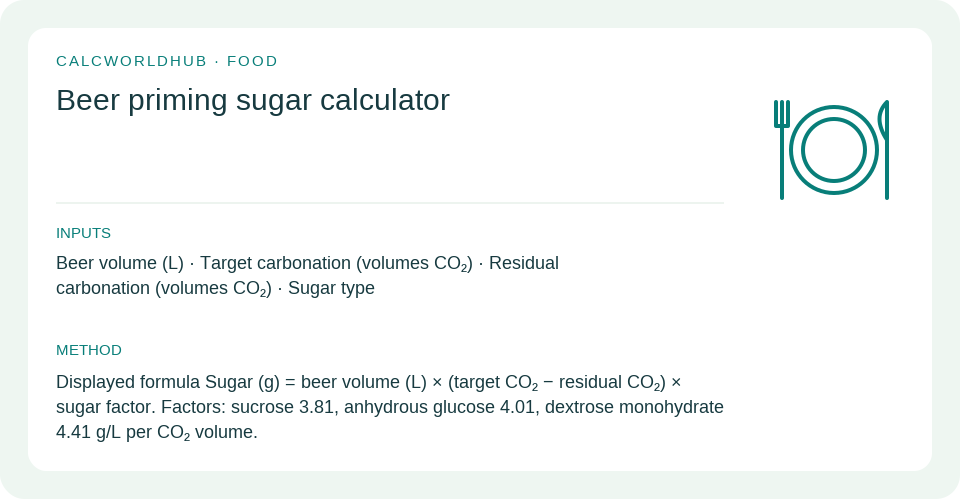
Sugar (g) = beer volume (L) × (target CO₂ − residual CO₂) × sugar factor. Factors: sucrose 3.81, anhydrous glucose 4.01, dextrose monohydrate 4.41 g/L per CO₂ volume.
Method
Enter beer volume in liters, target and residual CO₂ volumes, and the sugar type. The output applies the selected factor to the carbonation difference.
Worked example
For 19 L targeting 2.40 volumes with 0.85 residual, the difference is 1.55 volumes. At 3.81 g/L per volume, estimated sucrose is 112.2 g.
Assumptions and limits
Actual dissolved CO₂, fermentation completion, sugar purity, and yeast activity affect results. This tool does not estimate residual CO₂ from temperature or assess bottle-pressure safety. Confirm fermentation and package pressure rating.
Frequently asked questions
Why enter residual CO₂ directly?
Dissolved CO₂ depends on fermentation and handling; this tool does not infer it from temperature.
Why does sugar type change mass?
Fermentable sugars yield different CO₂ per gram; the factors are simplified stoichiometric estimates.
Does this check bottle safety?
No. Use packaging rated for the expected pressure and do not package before fermentation is complete.
How do I use the Beer priming sugar calculator?
Enter Beer volume (L), Target carbonation (volumes CO₂), Residual carbonation (volumes CO₂), Sugar type. Match the units shown beside each field and review the result together with the assumptions below.
What is a worked example of Beer priming sugar?
For 19 L targeting 2.40 volumes with 0.85 residual, the difference is 1.55 volumes. At 3.81 g/L per volume, estimated sucrose is 112.2 g.
Reference: PubChem sucrose molecular formula and mass record. See our calculation methodology.