How to use this calculator
Bound how many payload bits a binary block code could carry while uniquely correcting every error pattern up to a chosen weight.
- Enter Codeword length (bits), Corrected arbitrary bit errors. Match the units shown beside each field and review the result together with the assumptions below.
- Read the worked example below to check the expected input format and result.
- Compare another scenario by changing one input at a time. Use Reset to return to the starting values.
Binary block-code sphere-packing bound explained
For correction radius t, each codeword occupies a Hamming sphere containing Σ C(n,j) error patterns for j=0…t. Disjoint spheres must fit among all 2ⁿ binary words, which gives a necessary payload bound but does not prove that a code meeting it exists.
Inputs, symbols, and units
n— Codeword length (bits)- Total bits in each binary block. Enter a whole number.
t— Corrected arbitrary bit errors- Maximum Hamming radius around each codeword. Enter a whole number.
Formula and method
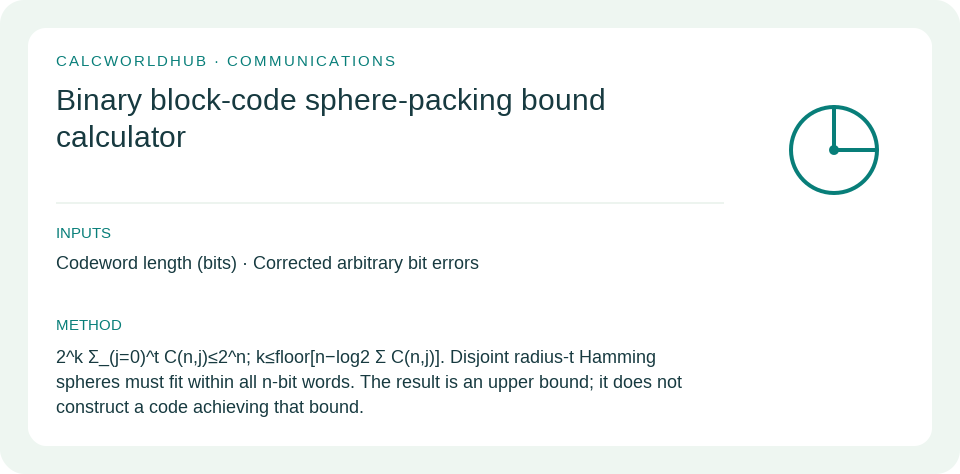
2^k Σ_(j=0)^t C(n,j)≤2^n; k≤floor[n−log2 Σ C(n,j)].
Disjoint radius-t Hamming spheres must fit within all n-bit words. The result is an upper bound; it does not construct a code achieving that bound.
A worked scenario
Codeword length (bits) = 31; Corrected arbitrary bit errors = 3.
- Maximum information bits under Hamming bound: 18 bits
- Minimum redundancy bound: 13 bits
- Error-sphere size: 4992 patterns
For 31-bit blocks correcting all patterns of up to three bit errors, count the full correction sphere before assigning a maximum possible payload.
Assumptions and edge cases
Necessary sphere-packing condition, not sufficient existence proof; no soft decisions, erasures or channel-specific performance.
Reading the outputs
Information-bit bound and redundancy bound refer to binary block codes. Error-sphere size counts patterns per codeword.
Frequently asked questions
Does the result guarantee a usable code?
No; many parameter combinations satisfy this bound without a known or feasible code achieving it.
Why include the zero-error pattern?
The received codeword itself belongs to each decoding sphere.
Is this a BER prediction?
No; it counts correctable patterns and does not assign their probabilities.
How do I use the Binary block-code sphere-packing bound calculator?
Enter Codeword length (bits), Corrected arbitrary bit errors. Match the units shown beside each field and review the result together with the assumptions below.
What is a worked example of Binary block-code sphere-packing bound?
Codeword length (bits) = 31; Corrected arbitrary bit errors = 3. Maximum information bits under Hamming bound: 18 bits Minimum redundancy bound: 13 bits Error-sphere size: 4992 patterns For 31-bit blocks correcting all patterns of up to three bit errors, count the full correction sphere before assigning a maximum possible payload.
Background or definition reference: MIT digital communication error-correcting codes.
Read our calculation methodology.