How to use this calculator
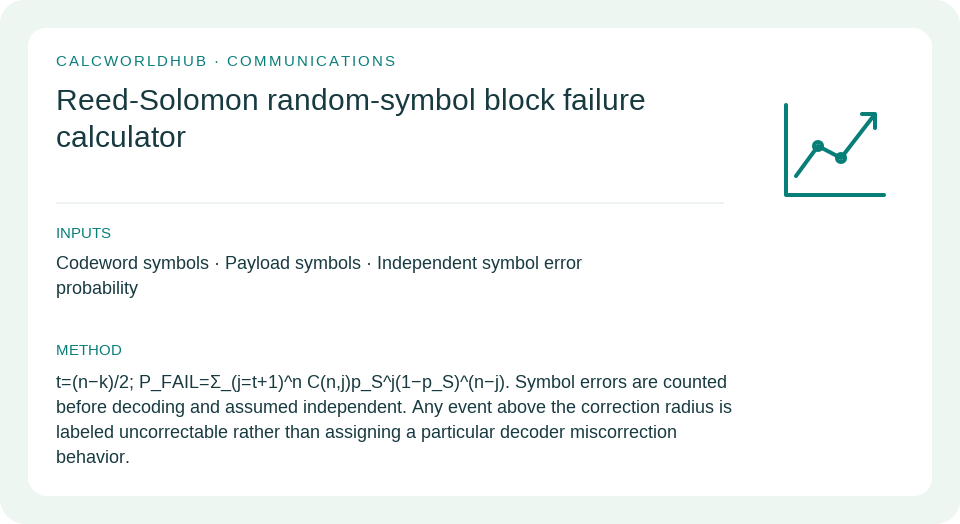
Estimate how often a bounded-distance Reed-Solomon decoder receives more erroneous symbols than its correction radius.
- Enter Codeword symbols, Payload symbols, Independent symbol error probability. Match the units shown beside each field and review the result together with the assumptions below.
- Read the worked example below to check the expected input format and result.
- Compare another scenario by changing one input at a time. Use Reset to return to the starting values.
Reed-Solomon random-symbol block failure explained
Estimate how often independent symbol errors exceed a Reed–Solomon code’s correction radius for a chosen codeword length and payload length.
How the calculation works
t=(n−k)/2; P_FAIL=Σ_(j=t+1)^n C(n,j)p_S^j(1−p_S)^(n−j).
Symbol errors are counted before decoding and assumed independent. Any event above the correction radius is labeled uncorrectable rather than assigning a particular decoder miscorrection behavior.
Set up the calculation
n— Codeword symbols- Total symbols per codeword. Enter a whole number.
k— Payload symbols- Information symbols; n−k are parity symbols. Enter a whole number.
p— Independent symbol error probability- Probability that a whole received symbol is wrong.
Limits of this model
No erasure assistance, burst correlation or decoder-specific failure detection; field-size and code construction feasibility must be checked separately.
Check this example
Codeword symbols = 255; Payload symbols = 223; Independent symbol error probability = 0.01.
- Uncorrectable block probability: 1.40022869e-09 probability
- Correctable symbol errors: 16 symbols
- Code rate: 0.87451 payload/coded symbols
A 255/223 block has sixteen-symbol correction capability; a one-percent independent symbol error rate gives a small but nonzero block-failure tail.
Reading the outputs
Failure probability is per complete block. Code rate uses symbol counts, which cancel for fixed symbol width.
Frequently asked questions
Can bit-error rate be entered directly?
Only if each symbol is one bit; otherwise first convert BER to symbol-error probability using the symbol model.
Does a burst obey this result?
Usually not; independent random symbols are the core assumption.
Does above-radius mean the decoder always flags failure?
No; some events can miscorrect. This reports the uncorrectable input-event probability.
How do I use the Reed-Solomon random-symbol block failure calculator?
Enter Codeword symbols, Payload symbols, Independent symbol error probability. Match the units shown beside each field and review the result together with the assumptions below.
What is a worked example of Reed-Solomon random-symbol block failure?
Codeword symbols = 255; Payload symbols = 223; Independent symbol error probability = 0.01. Uncorrectable block probability: 1.40022869e-09 probability Correctable symbol errors: 16 symbols Code rate: 0.87451 payload/coded symbols A 255/223 block has sixteen-symbol correction capability; a one-percent independent symbol error rate gives a small but nonzero block-failure tail.
Background or definition reference: MIT digital communication error-correcting codes.