Reed Solomon error and erasure budget calculator
Calculate the remaining unknown-symbol error budget of a Reed–Solomon code after accounting for known-location erasures.
How to use this calculator
Calculate the remaining unknown-symbol error budget of a Reed–Solomon code after accounting for known-location erasures.
- Enter Codeword symbols n, Data symbols k, Known-location erasures. Match the units shown beside each field and review the result together with the assumptions below.
- Read the worked example below to check the expected input format and result.
- Compare another scenario by changing one input at a time. Use Reset to return to the starting values.
How the Reed Solomon error and erasure budget calculator works
Calculate the remaining unknown-symbol error budget of a Reed–Solomon code after accounting for known-location erasures.
Inputs and units
- Codeword symbols n: Total codeword symbol count n, a positive integer.
- Data symbols k: Message symbol count k, a positive integer no greater than n.
- Known-location erasures: Known-location erased symbols; a nonnegative integer not exceeding n−k.
Formula and method
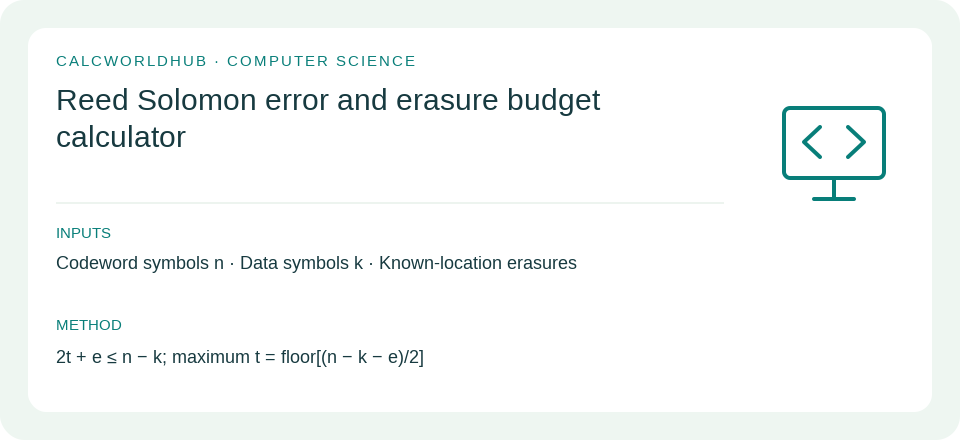
2t + e ≤ n − k; maximum t = floor[(n − k − e)/2]
Worked example
For n = 255, k = 223, and 4 erasures: 32 parity symbols remain in the code, and floor((32−4)/2) = 14 unknown symbol errors can be corrected within the bound.
Interpreting the result
An unknown-location error consumes two parity symbols in this bound, while a known-location erasure consumes one.
Assumptions and limits
Counts are symbols, not individual bits. This checks the algebraic budget only; field size, generator polynomial, shortening, puncturing, and decoder behavior must match the actual code.
Sources and method
- States the combined symbol-error and erasure bound 2t+e≤n−k. Open University: Reed–Solomon error correction
Frequently asked questions
Is a symbol error the same as a bit error?
No. A symbol can contain several bits; multiple changed bits within one symbol count as one symbol error.
Why can one more erasure leave the error budget unchanged?
The maximum unknown-error count is rounded down, so adjacent parity budgets can have the same floor.
How do I use the Reed Solomon error and erasure budget calculator?
Enter Codeword symbols n, Data symbols k, Known-location erasures. Match the units shown beside each field and review the result together with the assumptions below.
What is a worked example of Reed Solomon error and erasure budget?
For n = 255, k = 223, and 4 erasures: 32 parity symbols remain in the code, and floor((32−4)/2) = 14 unknown symbol errors can be corrected within the bound.
What does the Reed Solomon error and erasure budget calculator calculate?
Calculate the remaining unknown-symbol error budget of a Reed–Solomon code after accounting for known-location erasures.
See the calculation methodology.