How to use this calculator
Separate guaranteed single-error recovery, detected double errors and beyond-guarantee events for an extended Hamming SECDED block.
- Enter Total extended-Hamming block bits, Independent raw bit-error probability. Match the units shown beside each field and review the result together with the assumptions below.
- Read the worked example below to check the expected input format and result.
- Compare another scenario by changing one input at a time. Use Reset to return to the starting values.
SECDED block outcome probabilities explained
As the independent raw bit-error probability rises, the probability of multiple errors grows and the one-error-correctable share falls.
Inputs, symbols, and units
n— Total extended-Hamming block bits- Full protected block including overall parity. Enter a whole number.
p— Independent raw bit-error probability- Equal independent bit-error probability before decoding.
Formula and method
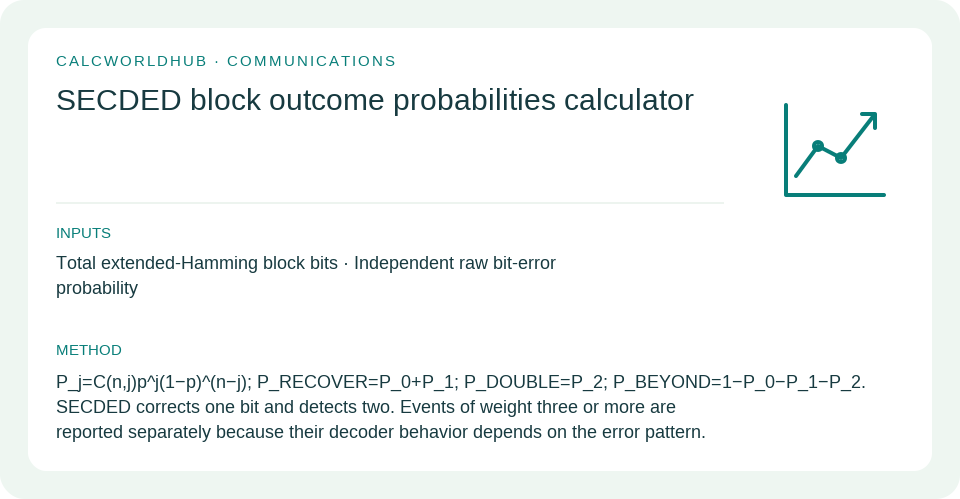
P_j=C(n,j)p^j(1−p)^(n−j); P_RECOVER=P_0+P_1; P_DOUBLE=P_2; P_BEYOND=1−P_0−P_1−P_2.
SECDED corrects one bit and detects two. Events of weight three or more are reported separately because their decoder behavior depends on the error pattern.
A worked scenario
Total extended-Hamming block bits = 72; Independent raw bit-error probability = 0.001.
- Correctly recovered zero-or-one-error probability: 0.99756 probability
- Detected double-error probability: 0.002383 probability
- Three-or-more-error probability: 0.000057 probability
A 72-bit protected memory-style block at raw BER 0.001 is usually error free, but its rare double and higher-weight events need different handling.
Assumptions and edge cases
Assumes an actual valid extended Hamming construction and independent equal-probability errors; it does not validate a code construction from n alone.
Reading the outputs
Probabilities describe channel error weights, not a universal undetected-error rate for a particular decoder implementation.
Frequently asked questions
Are all triple errors detected?
No general SECDED guarantee applies beyond two errors; some can cause miscorrection.
Can a correlated radiation burst be modeled with independent p?
Not reliably; burst or multiple-cell upset statistics need their own model.
Why report detected doubles separately?
They require retry or higher-level recovery rather than single-bit correction.
How do I use the SECDED block outcome probabilities calculator?
Enter Total extended-Hamming block bits, Independent raw bit-error probability. Match the units shown beside each field and review the result together with the assumptions below.
What is a worked example of SECDED block outcome probabilities?
Total extended-Hamming block bits = 72; Independent raw bit-error probability = 0.001. Correctly recovered zero-or-one-error probability: 0.99756 probability Detected double-error probability: 0.002383 probability Three-or-more-error probability: 0.000057 probability A 72-bit protected memory-style block at raw BER 0.001 is usually error free, but its rare double and higher-weight events need different handling.
Background or definition reference: MIT digital communication error-correcting codes.
Read our calculation methodology.