How to use this calculator
Translate independent channel bit errors into whole-frame integrity and useful payload throughput without retransmissions.
- Enter Independent bit-error probability, Payload bits per frame, Header and check bits, Raw channel bit rate (bit/s). Match the units shown beside each field and review the result together with the assumptions below.
- Read the worked example below to check the expected input format and result.
- Compare another scenario by changing one input at a time. Use Reset to return to the starting values.
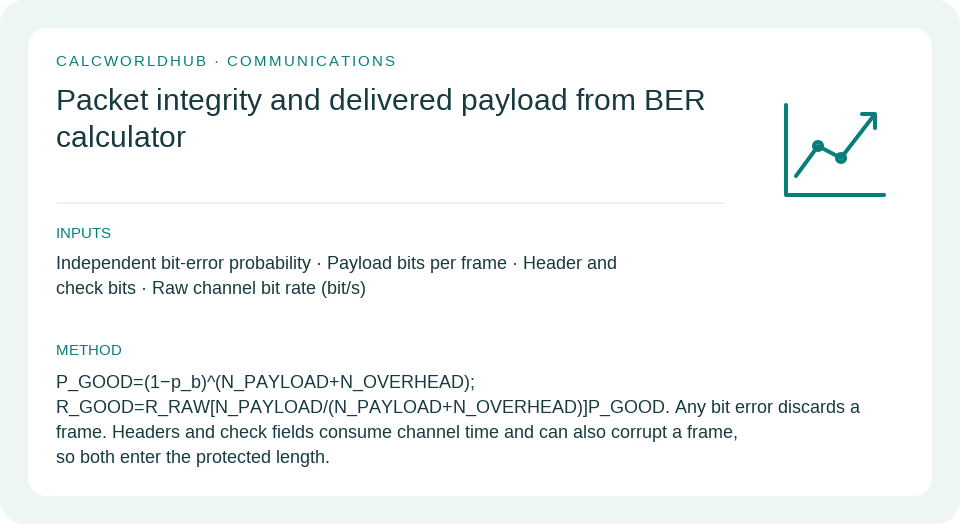
Packet integrity and delivered payload from BER explained
Estimate useful payload throughput after frame overhead and the chance that any protected bit corrupts a frame.
How the calculation works
P_GOOD=(1−p_b)^(N_PAYLOAD+N_OVERHEAD); R_GOOD=R_RAW[N_PAYLOAD/(N_PAYLOAD+N_OVERHEAD)]P_GOOD.
Any bit error discards a frame. Headers and check fields consume channel time and can also corrupt a frame, so both enter the protected length.
Set up the calculation
ber— Independent bit-error probability- Probability of error per transmitted protected bit.
payload— Payload bits per frame- Useful delivered bits if the full frame is error free. Enter a whole number.
overhead— Header and check bits- Additional transmitted bits subject to frame failure. Enter a whole number.
rate— Raw channel bit rate (bit/s)- Total transmitted bit rate including frame overhead.
Limits of this model
Independent equal-probability errors and perfect frame-error detection; burst errors, FEC and undetected CRC events are excluded.
Check this example
Independent bit-error probability = 0.00001; Payload bits per frame = 8000; Header and check bits = 320; Raw channel bit rate (bit/s) = 1000000.
- Error-free payload rate: 884775.685197 bit/s
- Frame error probability: 0.079833 probability
- Error-free frame probability: 0.920167 probability
An 8000-bit payload plus 320 overhead bits sent at 1 Mbit/s with BER 10^−5 loses more frames than the bare bit-error percentage suggests.
The protected frame error probability is about 0.079833 and delivered payload rate is about 884,775.7 bit/s under independent bit errors.
Reading the outputs
Delivered payload rate excludes errored frames and overhead. It does not subtract acknowledgments or retransmission scheduling.
Frequently asked questions
Why can a tiny BER yield many bad frames?
A long frame offers thousands of opportunities for at least one bit error.
Does this model automatic repeat request?
No; it reports useful first-pass payload without retransmission timing.
Can errors in the header be ignored?
Only if your protocol protects or handles them separately; this model includes every entered frame bit.
How do I use the Packet integrity and delivered payload from BER calculator?
Enter Independent bit-error probability, Payload bits per frame, Header and check bits, Raw channel bit rate (bit/s). Match the units shown beside each field and review the result together with the assumptions below.
What is a worked example of Packet integrity and delivered payload from BER?
Independent bit-error probability = 0.00001; Payload bits per frame = 8000; Header and check bits = 320; Raw channel bit rate (bit/s) = 1000000. Error-free payload rate: 884775.685197 bit/s Frame error probability: 0.079833 probability Error-free frame probability: 0.920167 probability An 8000-bit payload plus 320 overhead bits sent at 1 Mbit/s with BER 10^−5 loses more frames than the bare bit-error percentage suggests. The protected frame error probability is about 0.079833 and delivered payload rate is about 884,775.7 bit/s under independent bit errors.
Read our calculation methodology.