MTU payload packet count calculator
Estimate packets needed to carry a data payload when each packet has fixed protocol overhead. Enter your values below to see the result and method.
inputs.
Related calculators and articles
Compare methods and explore more free tools in computer science.
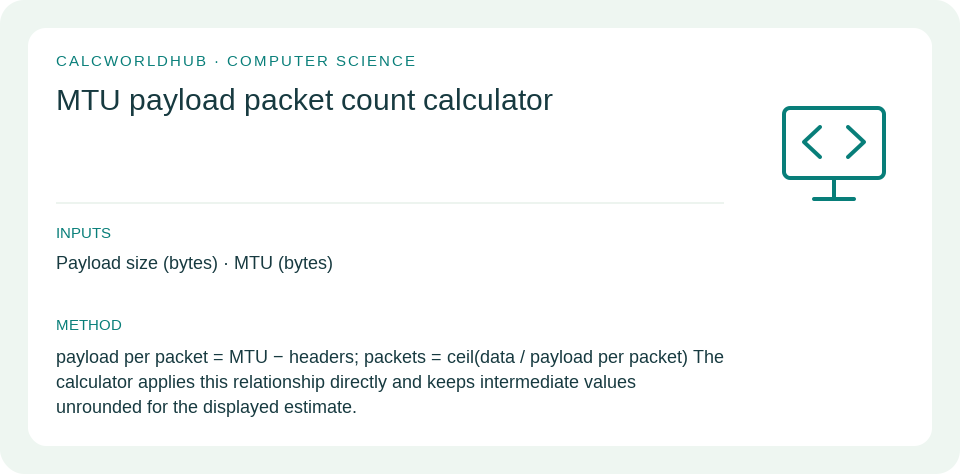
How to use the MTU payload packet count calculator
Estimate packets needed to carry a data payload when each packet has fixed protocol overhead. Use the free tool above without creating an account.
What it calculates
Estimate packets needed to carry a data payload when each packet has fixed protocol overhead. The output reflects the input definitions and conventions used by the formula, so keep formats and units consistent when comparing scenarios.
Inputs and units
Enter Payload size (bytes) and MTU (bytes). Review the labels and example values before calculating.
- Payload size (bytes): enter a value in the unit shown; the browser checks the accepted format and range.
- MTU (bytes): enter a value in the unit shown; the browser checks the accepted format and range.
Protocol header bytes are subtracted from each packet MTU to estimate payload capacity.
Formula and method
payload per packet = MTU − headers; packets = ceil(data / payload per packet)
The calculator applies this relationship directly and keeps intermediate values unrounded for the displayed estimate.
Worked example
With a 5,000-byte payload, 1,500-byte MTU, and 40 bytes of headers, 4 packets are needed.
How to interpret the result
Use the result to answer the specific sizing, encoding, performance, or representation question stated on this page. It is conditional on the chosen inputs; change one input at a time to see how the estimate responds.
Assumptions and limitations
This simplified estimate assumes one fixed header size per packet and no additional fragmentation headers, tunnels, or retransmissions.
Frequently asked questions
How is usable payload per packet determined?
Subtract the entered protocol-header bytes from the MTU. The remaining bytes are the maximum data payload per packet in this simplified model; the total is rounded up to a whole packet.
Which formula does it use?
payload per packet = MTU − headers; packets = ceil(data / payload per packet) The guide above explains the input conventions and a worked example.
What should I check before relying on the result?
This simplified estimate assumes one fixed header size per packet and no additional fragmentation headers, tunnels, or retransmissions. Confirm that the units, widths, and system conventions match your use case.
How do I use the MTU payload packet count calculator?
Enter Payload size (bytes), MTU (bytes). Match the units shown beside each field and review the result together with the assumptions below.
What is a worked example of MTU payload packet count?
With a 5,000-byte payload, 1,500-byte MTU, and 40 bytes of headers, 4 packets are needed.
Read the calculation methodology and privacy policy.