How to use this calculator
Compare uncoded binary detector error rates at a common energy-per-bit budget under additive white Gaussian noise.
- Enter Eb over N0 (dB), Binary detector model. Match the units shown beside each field and review the result together with the assumptions below.
- Read the worked example below to check the expected input format and result.
- Compare another scenario by changing one input at a time. Use Reset to return to the starting values.
Binary modulation AWGN bit-error comparison explained
Compare uncoded bit-error probabilities for coherent and differential binary modulation over an additive white Gaussian-noise channel.
A numerical walkthrough
Eb over N0 (dB) = 6; Binary detector model = coherent BPSK.
- Uncoded bit error probability: 0.002388 probability
- Bit errors per million bits: 2388.290826 expected errors
- Linear Eb over N0: 3.981072 linear
At 6 dB Eb/N0 compare coherent BPSK with differential detection; the detector penalty appears directly in expected errors per million bits.
The model behind the numbers
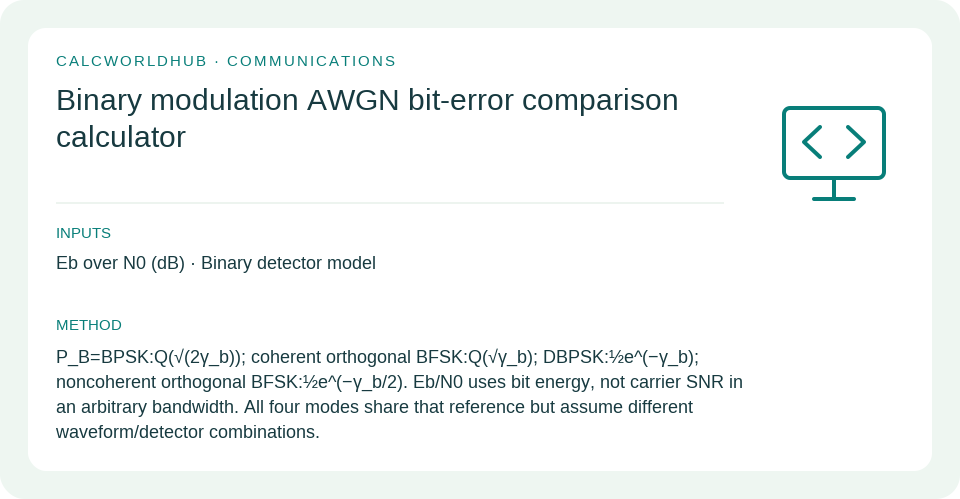
P_B=BPSK:Q(√(2γ_b)); coherent orthogonal BFSK:Q(√γ_b); DBPSK:½e^(−γ_b); noncoherent orthogonal BFSK:½e^(−γ_b/2).
Eb/N0 uses bit energy, not carrier SNR in an arbitrary bandwidth. All four modes share that reference but assume different waveform/detector combinations.
What to enter
eb— Eb over N0 (dB)- Energy per uncoded information bit divided by noise spectral density.
mode— Binary detector model- Choose the stated coherent/noncoherent detector assumptions. Choose coherent BPSK, coherent orthogonal BFSK, differential BPSK, noncoherent orthogonal BFSK.
Interpreting the result
Uncoded equiprobable independent bits in AWGN, ideal synchronization where required; no fading, interference or coding gain.
Reading the outputs
BER is an expected probability. Errors per million is its expectation, not a guarantee of evenly spaced errors.
Frequently asked questions
Is Eb/N0 equal to SNR?
Only for a particular relationship between bit rate and noise bandwidth; generally Eb/N0=SNR times B/Rb.
Does differential detection require carrier phase recovery?
It uses phase changes rather than absolute carrier phase, with a corresponding error-rate tradeoff.
Does this include forward error correction?
No; apply a coding model separately.
How do I use the Binary modulation AWGN bit-error comparison calculator?
Enter Eb over N0 (dB), Binary detector model. Match the units shown beside each field and review the result together with the assumptions below.
What is a worked example of Binary modulation AWGN bit-error comparison?
Eb over N0 (dB) = 6; Binary detector model = coherent BPSK. Uncoded bit error probability: 0.002388 probability Bit errors per million bits: 2388.290826 expected errors Linear Eb over N0: 3.981072 linear At 6 dB Eb/N0 compare coherent BPSK with differential detection; the detector penalty appears directly in expected errors per million bits.
Background or definition reference: MathWorks analytical BER expressions.
Read our calculation methodology.