How to use this calculator
Build a sensitivity target from noise bandwidth, noise figure and required demodulator SNR instead of assuming a receiver threshold.
- Enter Receiver noise bandwidth (Hz), Reference source temperature (K), Receiver noise figure (dB), Required demodulator SNR (dB), then complete the remaining labeled fields. Match the units shown beside each field and review the result together with the assumptions below.
- Read the worked example below to check the expected input format and result.
- Compare another scenario by changing one input at a time. Use Reset to return to the starting values.
Thermal-noise receiver sensitivity explained
Receiver sensitivity combines the accepted thermal-noise power, receiver noise figure, required demodulator SNR, and an implementation allowance. All terms must refer to compatible bandwidth and temperature conventions; propagation losses belong in a separate link budget.
Inputs, symbols, and units
B— Receiver noise bandwidth (Hz)- Equivalent rectangular bandwidth over which noise is accepted.
T— Reference source temperature (K)- Source noise temperature for the input noise floor.
NF— Receiver noise figure (dB)- Noise figure referenced to the same source temperature.
SNR— Required demodulator SNR (dB)- Required signal/noise ratio in entered receiver bandwidth.
loss— Implementation allowance (dB)- Additional signal requirement for nonideal implementation.
Formula and method
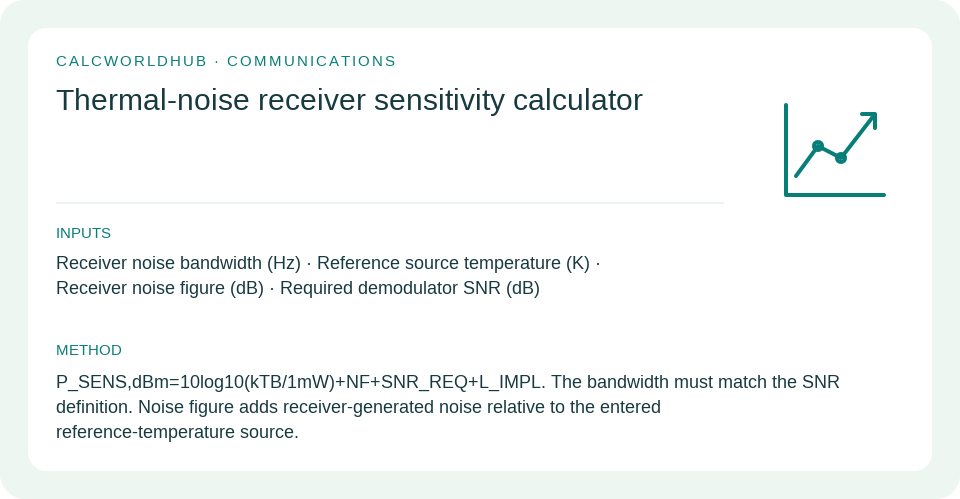
P_SENS,dBm=10log10(kTB/1mW)+NF+SNR_REQ+L_IMPL.
The bandwidth must match the SNR definition. Noise figure adds receiver-generated noise relative to the entered reference-temperature source.
A worked scenario
Receiver noise bandwidth (Hz) = 200000; Reference source temperature (K) = 290; Receiver noise figure (dB) = 5; Required demodulator SNR (dB) = 10; Implementation allowance (dB) = 2.
- Required input signal: -103.964887 dBm
- Input-referred receiver noise: -115.964887 dBm
- Required input power: 4.01338919e-14 W
A 200 kHz receiver at 290 K with 5 dB noise figure, 10 dB SNR requirement and 2 dB implementation allowance yields a specific minimum input power.
Assumptions and edge cases
White thermal noise, matched reference source and a supplied demodulator requirement. The entered noise figure must apply at the entered reference temperature; a specification referenced to 290 K cannot automatically be moved to another temperature without considering receiver noise temperature. Interference, fading and blocking are excluded.
Reading the outputs
Sensitivity is a required signal level; the noise result excludes the SNR and implementation allowances.
Frequently asked questions
Can channel spacing replace noise bandwidth?
Only if the receiver noise bandwidth equals that spacing; filters usually require an equivalent-noise-bandwidth correction.
Is a lower sensitivity number better?
A more negative required dBm value indicates the receiver can tolerate a weaker signal under these assumptions.
Where is fading margin?
Add propagation margin in the link budget; it is not receiver thermal noise.
How do I use the Thermal-noise receiver sensitivity calculator?
Enter Receiver noise bandwidth (Hz), Reference source temperature (K), Receiver noise figure (dB), Required demodulator SNR (dB), then complete the remaining labeled fields. Match the units shown beside each field and review the result together with the assumptions below.
What is a worked example of Thermal-noise receiver sensitivity?
Receiver noise bandwidth (Hz) = 200000; Reference source temperature (K) = 290; Receiver noise figure (dB) = 5; Required demodulator SNR (dB) = 10; Implementation allowance (dB) = 2. Required input signal: -103.964887 dBm Input-referred receiver noise: -115.964887 dBm Required input power: 4.01338919e-14 W A 200 kHz receiver at 290 K with 5 dB noise figure, 10 dB SNR requirement and 2 dB implementation allowance yields a specific minimum input power.
Background or definition reference: NASA Deep Space Network noise-temperature concepts.
Read our calculation methodology.