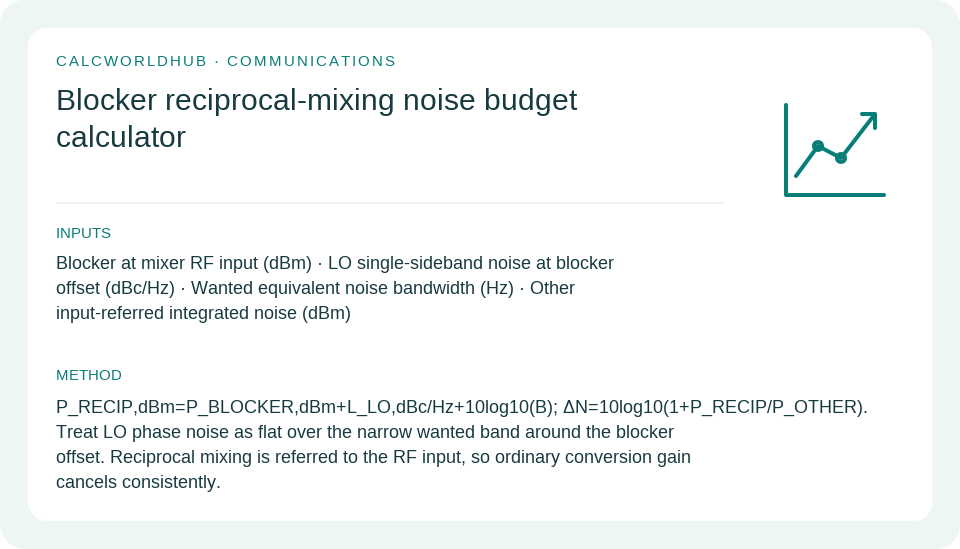
How to use this calculator
Assess whether a strong nearby blocker will raise the receive noise floor through local-oscillator phase noise.
- Enter Blocker at mixer RF input (dBm), LO single-sideband noise at blocker offset (dBc/Hz), Wanted equivalent noise bandwidth (Hz), Other input-referred integrated noise (dBm). Match the units shown beside each field and review the result together with the assumptions below.
- Read the worked example below to check the expected input format and result.
- Compare another scenario by changing one input at a time. Use Reset to return to the starting values.
Blocker reciprocal-mixing noise budget explained
A strong blocker can mix with local-oscillator phase-noise sidebands and raise the receiver noise floor. Estimate the reciprocal-mixing contribution across the wanted bandwidth, then add it to the other input-referred noise in linear power.
Inputs, symbols, and units
blocker— Blocker at mixer RF input (dBm)- Strong unwanted tone present at the mixer input.
phase— LO single-sideband noise at blocker offset (dBc/Hz)- Approximately flat phase-noise density over the wanted receive band.
B— Wanted equivalent noise bandwidth (Hz)- Noise bandwidth over which downconverted blocker noise accumulates.
thermal— Other input-referred integrated noise (dBm)- Thermal and receiver noise integrated over the same bandwidth.
Formula and method
P_RECIP,dBm=P_BLOCKER,dBm+L_LO,dBc/Hz+10log10(B); ΔN=10log10(1+P_RECIP/P_OTHER).
Treat LO phase noise as flat over the narrow wanted band around the blocker offset. Reciprocal mixing is referred to the RF input, so ordinary conversion gain cancels consistently.
A worked scenario
Blocker at mixer RF input (dBm) = -20; LO single-sideband noise at blocker offset (dBc/Hz) = -130; Wanted equivalent noise bandwidth (Hz) = 200000; Other input-referred integrated noise (dBm) = -115.
- Input-referred reciprocal mixing noise: -96.9897 dBm
- Total noise-floor increase: 18.078431 dB
- Combined input-referred noise: -96.921569 dBm
A −20 dBm blocker, −130 dBc/Hz LO noise and 200 kHz bandwidth can contribute meaningful noise even when the blocker lies outside the desired channel.
Assumptions and edge cases
Flat SSB phase noise, one blocker and linear mixer operation. Frequency-dependent noise skirts, multiple blockers and blocking compression need integration or measurement.
Reading the outputs
Noise increase is the dB rise above the other-noise input. Combined noise is a power sum, never an arithmetic average of dBm levels.
Frequently asked questions
Does a front-end filter help?
Reducing the blocker before the mixer lowers reciprocal noise by the same number of dB under this model.
Can I use carrier phase noise at zero offset?
No; use the LO phase-noise density at the actual blocker-to-wanted frequency spacing.
Why do I add powers rather than dBm values?
Independent noise contributions combine in watts; logarithmic powers must first be converted.
How do I use the Blocker reciprocal-mixing noise budget calculator?
Enter Blocker at mixer RF input (dBm), LO single-sideband noise at blocker offset (dBc/Hz), Wanted equivalent noise bandwidth (Hz), Other input-referred integrated noise (dBm). Match the units shown beside each field and review the result together with the assumptions below.
What is a worked example of Blocker reciprocal-mixing noise budget?
Blocker at mixer RF input (dBm) = -20; LO single-sideband noise at blocker offset (dBc/Hz) = -130; Wanted equivalent noise bandwidth (Hz) = 200000; Other input-referred integrated noise (dBm) = -115. Input-referred reciprocal mixing noise: -96.9897 dBm Total noise-floor increase: 18.078431 dB Combined input-referred noise: -96.921569 dBm A −20 dBm blocker, −130 dBc/Hz LO noise and 200 kHz bandwidth can contribute meaningful noise even when the blocker lies outside the desired channel.
Background or definition reference: Analog Devices reciprocal mixing and wideband LO noise.
Read our calculation methodology.