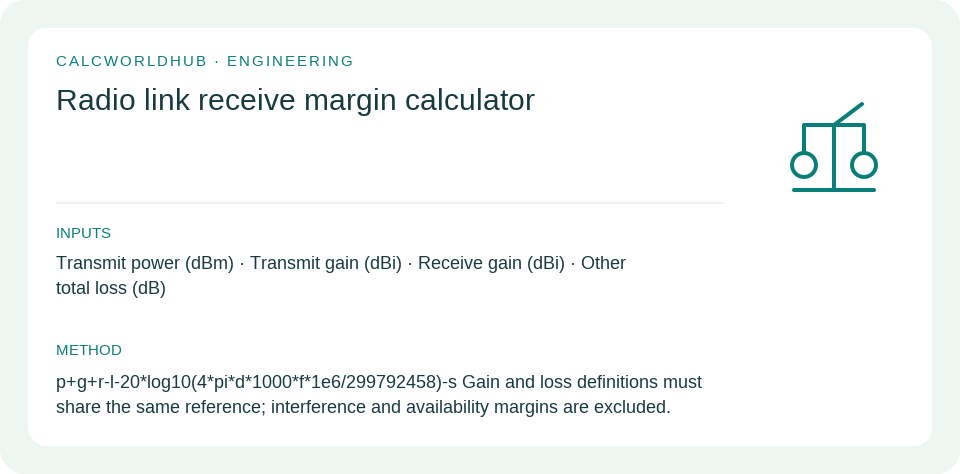
How to use this calculator
Combine a free-space path with entered powers, gains, losses, and receiver sensitivity.
- Enter Transmit power (dBm), Transmit gain (dBi), Receive gain (dBi), Other total loss (dB), then complete the remaining labeled fields. Match the units shown beside each field and review the result together with the assumptions below.
- Read the worked example below to check the expected input format and result.
- Compare another scenario by changing one input at a time. Use Reset to return to the starting values.
Radio link receive margin explained
A receive-margin estimate compares modeled received power with the receiver threshold for the selected radio mode. Transmit power and antenna gains are combined with free-space path loss and other entered losses; the result is a margin in dB rather than a received-power value in dBm.
Inputs, symbols, and units
p— Transmit power (dBm)- Transmitter output at the selected reference point, in dBm. Account for feed losses in the separate loss field.
g— Transmit gain (dBi)- Transmit antenna gain relative to an isotropic radiator, in dBi.
r— Receive gain (dBi)- Receive antenna gain relative to an isotropic radiator, in dBi.
l— Other total loss (dB)- Combined additional loss in dB, such as cables or connectors; do not include free-space loss twice.
d— Distance (km)- Positive path length in kilometers; the formula converts it to meters.
f— Frequency (MHz)- Positive carrier frequency in megahertz; the formula converts it to hertz.
s— Receiver sensitivity (dBm)- Receiver input threshold in dBm for the chosen bandwidth, data rate and error criterion.
Formula and method
p+g+r-l-20*log10(4*pi*d*1000*f*1e6/299792458)-s
Gain and loss definitions must share the same reference; interference and availability margins are excluded.
A worked scenario
Transmit power (dBm) = 20; Transmit gain (dBi) = 10; Receive gain (dBi) = 10; Other total loss (dB) = 3; Distance (km) = 1; Frequency (MHz) = 2400; Receiver sensitivity (dBm) = -85.
- Radio link receive margin: 21.947992 dB
At 1 km and 2,400 MHz, free-space loss is about 100.052 dB. Received power is 20+10+10−3−100.052 = −63.052 dBm; subtracting the −85 dBm sensitivity gives 21.948 dB of modeled margin.
Assumptions and edge cases
Gain and loss definitions must share the same reference; interference and availability margins are excluded.
Frequently asked questions
What does positive margin mean?
Modeled receive power exceeds the entered sensitivity.
Is sensitivity fixed across data rates?
No, use the applicable specification.
Does this guarantee connectivity?
No, propagation and interference can change it.
How do I use the Radio link receive margin calculator?
Enter Transmit power (dBm), Transmit gain (dBi), Receive gain (dBi), Other total loss (dB), then complete the remaining labeled fields. Match the units shown beside each field and review the result together with the assumptions below.
What is a worked example of Radio link receive margin?
Transmit power (dBm) = 20; Transmit gain (dBi) = 10; Receive gain (dBi) = 10; Other total loss (dB) = 3; Distance (km) = 1; Frequency (MHz) = 2400; Receiver sensitivity (dBm) = -85. Radio link receive margin: 21.947992 dB At 1 km and 2,400 MHz, free-space loss is about 100.052 dB. Received power is 20+10+10−3−100.052 = −63.052 dBm; subtracting the −85 dBm sensitivity gives 21.948 dB of modeled margin.
Reference: ITU-R P.525 free-space attenuation.
Read our calculation methodology.