How to use this calculator
Estimate geometric spreading loss for an unobstructed far-field radio link.
- Enter Separation (km), Frequency (MHz). Match the units shown beside each field and review the result together with the assumptions below.
- Read the worked example below to check the expected input format and result.
- Compare another scenario by changing one input at a time. Use Reset to return to the starting values.
Free space radio path loss explained
Use Separation (km) with Frequency (MHz) to reproduce the sample calculation, then review the stated limits before carrying the result into another scenario.
A numerical walkthrough
Separation (km) = 10; Frequency (MHz) = 2400.
- Free space radio path loss: 120.052008 dB
Displayed values are rounded only after calculation.
The model behind the numbers
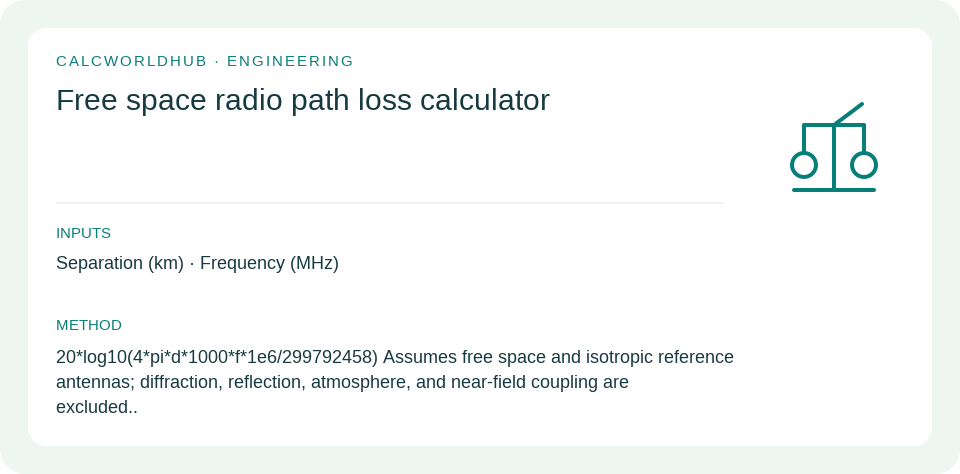
20*log10(4*pi*d*1000*f*1e6/299792458)
Assumes free space and isotropic reference antennas; diffraction, reflection, atmosphere, and near-field coupling are excluded..
What to enter
d— Separation (km)- Separation (km).
f— Frequency (MHz)- Frequency (MHz).
Interpreting the result
Assumes free space and isotropic reference antennas; diffraction, reflection, atmosphere, and near-field coupling are excluded.
Frequently asked questions
Does this include antenna gain?
No.
Can it predict an obstructed link?
Not alone.
Does distance need far-field separation?
Yes, the model assumes it.
How do I use the Free space radio path loss calculator?
Enter Separation (km), Frequency (MHz). Match the units shown beside each field and review the result together with the assumptions below.
What is a worked example of Free space radio path loss?
Separation (km) = 10; Frequency (MHz) = 2400. Free space radio path loss: 120.052008 dB Displayed values are rounded only after calculation.
Read our calculation methodology.