How to use this calculator
Calculate an observed bit error rate from a test’s error count and total transmitted bits.
- Enter Observed erroneous bits, Total bits tested. Match the units shown beside each field and review the result together with the assumptions below.
- Read the worked example below to check the expected input format and result.
- Compare another scenario by changing one input at a time. Use Reset to return to the starting values.
How this calculation works
Measured BER summarizes errors observed during a specific test interval. Enter the number of incorrect bits and the total tested bits from the same measurement window; the result is an empirical fraction rather than a model prediction.
Inputs and units
errors— Observed erroneous bits- Number of bit errors counted by the test instrument.
totalBits— Total bits tested- Total transmitted or checked bits in the same test.
Formula
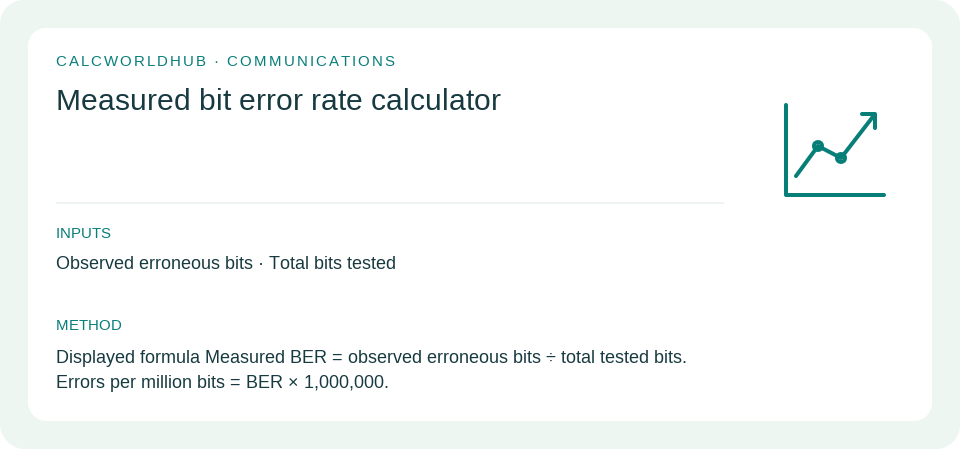
Measured BER = observed erroneous bits ÷ total tested bits. Errors per million bits = BER × 1,000,000.
Method
The observed error count must be a subset of the total tested bits. The rate describes the test sample and can vary with channel conditions and test length.
Worked example
A test with 37 errors in 10,000,000 bits has BER = 37 ÷ 10,000,000 = 3.7 × 10⁻⁶, or 3.7 errors per million bits.
Assumptions and limits
A zero-error test does not establish a true error probability of zero; it only reports no observed errors in the supplied sample. The estimate does not predict performance at other modulation, coding, SNR, or channel conditions.
Frequently asked questions
Is measured BER the same as theoretical BER?
No. This uses observed test errors; theoretical calculators estimate error probability from modulation and channel assumptions.
What does zero observed errors mean?
It means none occurred in this sample. A longer test may reveal rare errors.
Can I compare tests with different lengths?
The rate is normalized by bit count, but include test duration, channel conditions, equipment, and confidence limits when interpreting differences.
How do I use the Measured bit error rate calculator?
Enter Observed erroneous bits, Total bits tested. Match the units shown beside each field and review the result together with the assumptions below.
What is a worked example of Measured bit error rate?
A test with 37 errors in 10,000,000 bits has BER = 37 ÷ 10,000,000 = 3.7 × 10⁻⁶, or 3.7 errors per million bits.
Read our calculation methodology.