How to use this calculator
Estimate how square-QAM constellation density changes symbol errors and high-SNR Gray-coded bit errors at a given Eb/N0.
- Enter Square-QAM constellation size, Eb over N0 (dB). Match the units shown beside each field and review the result together with the assumptions below.
- Read the worked example below to check the expected input format and result.
- Compare another scenario by changing one input at a time. Use Reset to return to the starting values.
Square QAM AWGN symbol-error and BER estimate explained
Square-QAM symbol errors and bit errors are different probabilities. This model converts the entered bit-energy ratio from decibels to a linear ratio, calculates ideal coherent-detection symbol errors in AWGN, and reports a separately labeled nearest-neighbor Gray-code BER approximation.
Inputs, symbols, and units
M— Square-QAM constellation size- Power of four such as 4, 16, 64 or 256. Enter a whole number.
eb— Eb over N0 (dB)- Uncoded bit energy divided by noise spectral density.
Formula and method
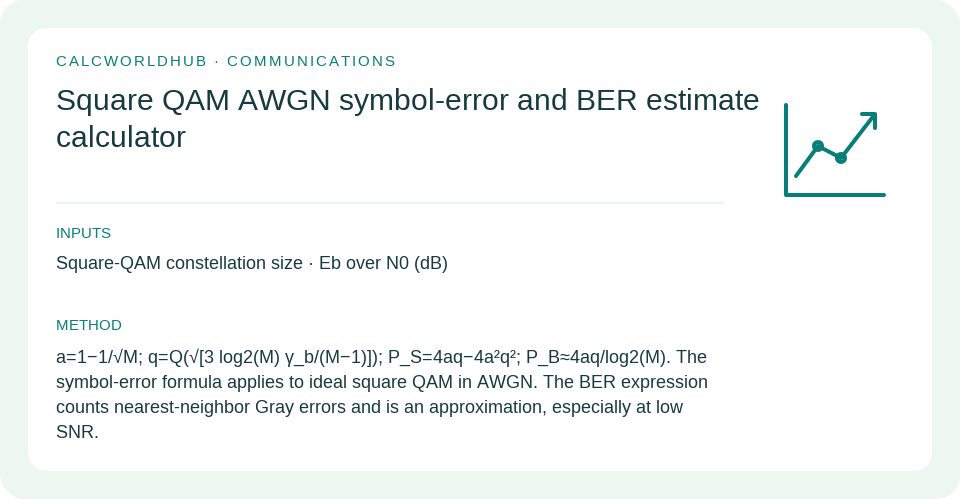
a=1−1/√M; q=Q(√[3 log2(M) γ_b/(M−1)]); P_S=4aq−4a²q²; P_B≈4aq/log2(M).
The symbol-error formula applies to ideal square QAM in AWGN. The BER expression counts nearest-neighbor Gray errors and is an approximation, especially at low SNR.
A worked scenario
Square-QAM constellation size = 64; Eb over N0 (dB) = 12.
- Symbol error probability: 0.057493 probability
- Nearest-neighbor Gray BER estimate: 0.009724 probability
- Bits per symbol: 6 bits
A 64-QAM constellation carries six bits per symbol; at 12 dB Eb/N0 evaluate both symbol-error probability and the separately labeled bit-error approximation.
Assumptions and edge cases
Uniform square QAM, equiprobable symbols, ideal coherent detection and no coding. Do not treat the BER approximation as exact at high error rates.
Reading the outputs
Symbol errors and bit errors use different denominators. Bits per symbol is reported so the conversion assumptions remain visible.
Frequently asked questions
Why is symbol error larger than bit error?
One incorrect symbol may change only one of its several Gray-labeled bits.
Can I enter 32-QAM?
No; rectangular or cross 32-QAM needs a different geometry.
Is the Gray BER expression exact?
It is a nearest-neighbor approximation; exact low-SNR BER requires label-specific error enumeration.
How do I use the Square QAM AWGN symbol-error and BER estimate calculator?
Enter Square-QAM constellation size, Eb over N0 (dB). Match the units shown beside each field and review the result together with the assumptions below.
What is a worked example of Square QAM AWGN symbol-error and BER estimate?
Square-QAM constellation size = 64; Eb over N0 (dB) = 12. Symbol error probability: 0.057493 probability Nearest-neighbor Gray BER estimate: 0.009724 probability Bits per symbol: 6 bits A 64-QAM constellation carries six bits per symbol; at 12 dB Eb/N0 evaluate both symbol-error probability and the separately labeled bit-error approximation.
Background or definition reference: MathWorks analytical BER expressions.
Read our calculation methodology.