Binomial standard deviation calculator
Calculate the standard deviation of a binomial count. Enter your values below for a free estimate, with no account required.
Calculator


How to use this calculator
Calculate binomial standard deviation from trial count and success probability. See its units and how model spread differs from observed results.
- Enter Number of trials n, Success probability p. Match the units shown beside each field and review the result together with the assumptions below.
- Read the worked example below to check the expected input format and result.
- Compare another scenario by changing one input at a time. Use Reset to return to the starting values.
Find the standard deviation of binomial successes
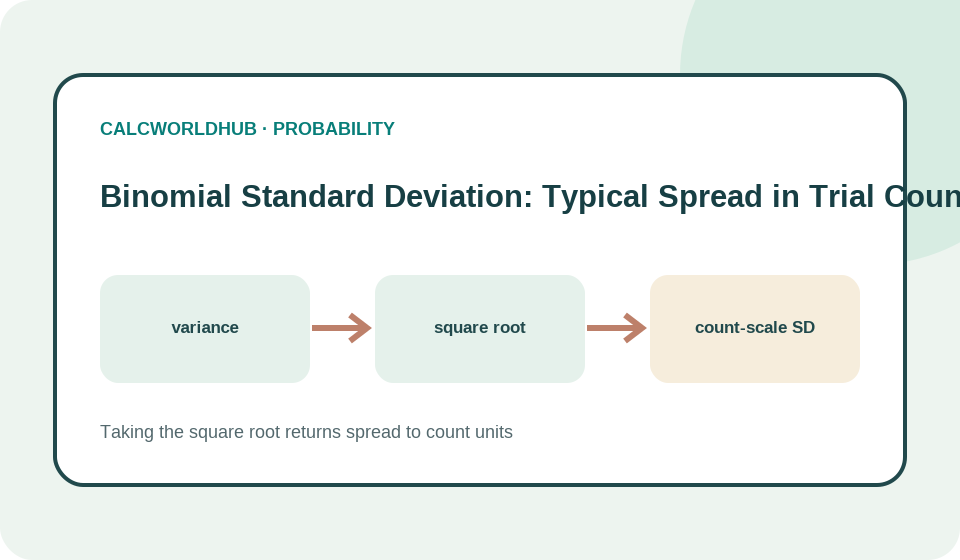
For n independent trials with the same success probability p, spread is √(np(1−p)). An observed-success count is not part of this theoretical standard deviation and was removed.
Inputs and units
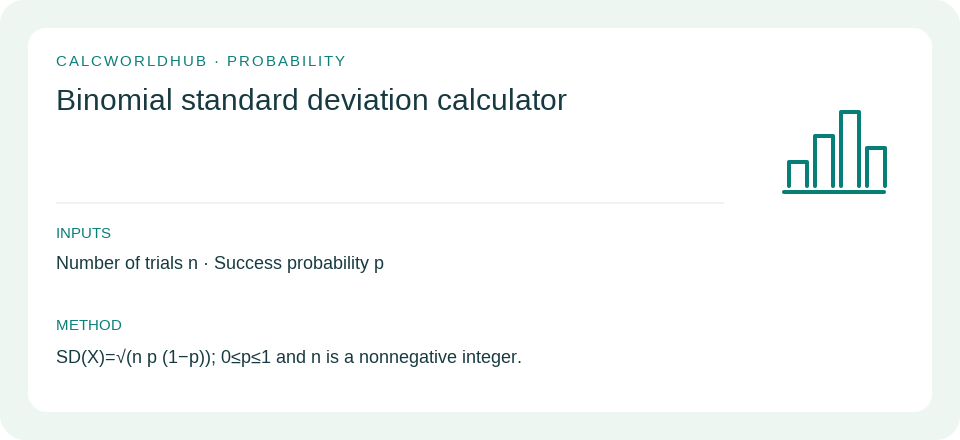
- Number of trials n
- Success probability p
Formula and method
SD(X)=√(n p (1−p)); 0≤p≤1 and n is a nonnegative integer.
Worked example
For n=12 and p=.30, SD=√(12×.30×.70)=√2.52≈1.5875 successes.
Interpreting the result
The standard deviation is measured in counts of successes; it describes model spread, not the observed outcome.
Assumptions and limits
Requires independent trials with constant success probability. The normal approximation to the distribution is a separate question.
Method references
Frequently asked questions
Does observed k change the standard deviation?
No. Under a binomial model, n and p determine its theoretical spread.
How do I use the Binomial standard deviation calculator?
Enter Number of trials n, Success probability p. Match the units shown beside each field and review the result together with the assumptions below.
What is a worked example of Binomial standard deviation?
For n=12 and p=.30, SD=√(12×.30×.70)=√2.52≈1.5875 successes.
What does the Binomial standard deviation calculator calculate?
Calculate binomial standard deviation from trial count and success probability. See its units and how model spread differs from observed results.
What assumptions apply to Binomial standard deviation?
Requires independent trials with constant success probability. The normal approximation to the distribution is a separate question.
Good calculators show their work.
CalcWorldHub is built around clear inputs and visible assumptions. Results are estimates for planning; check official sources or your provider’s terms when exact figures matter.