Binomial variance calculator
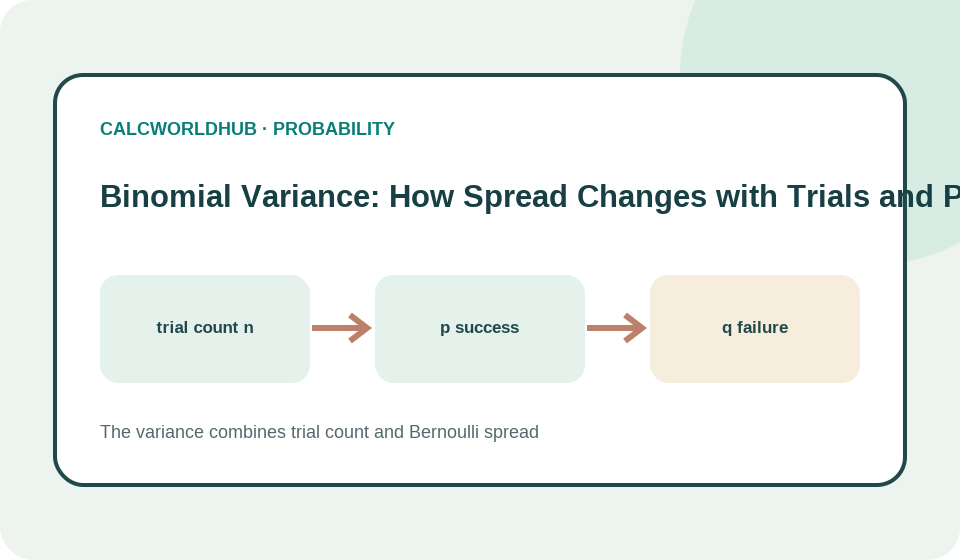
Calculate the variance in the number of successes across fixed independent Bernoulli trials.
Calculator


How to use this calculator
Calculate the variance in the number of successes across fixed independent Bernoulli trials.
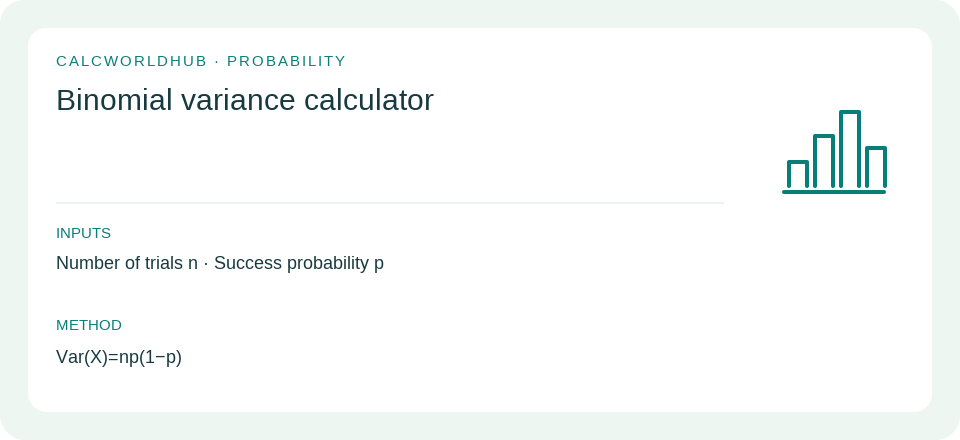
- Enter Number of trials n, Success probability p. Match the units shown beside each field and review the result together with the assumptions below.
- Read the worked example below to check the expected input format and result.
- Compare another scenario by changing one input at a time. Use Reset to return to the starting values.
Binomial variance calculator
Calculate the variance in the number of successes across fixed independent Bernoulli trials.
What it measures
Calculate the variance in the number of successes across fixed independent Bernoulli trials.
Inputs and units
- Number of trials n: Use a count from the same population, table, or experiment described by this calculator; counts are not measurements in physical units.
- Success probability p: Enter a proportion on the 0–1 scale stated in the label, not a percent from 0 to 100.
Formula and method
Var(X)=np(1−p)
Worked example
For n=12 trials and success probability p=0.30, Var(X)=12×0.30×0.70=2.52 successes squared.
Interpreting the result
Variance is measured in squared counts; its square root is the standard deviation in counts. It describes repeated-trial spread, not an observed count.
Assumptions and limits
n must be a nonnegative whole number and p must be from 0 to 1. Trials are assumed independent with one common success probability.
Sources and method
- Defines the binomial trial count and success probability, and gives variance np(1−p). OpenStax Introductory Statistics: Binomial distribution
Frequently asked questions
Why is variance zero at p=0 or p=1?
Every trial then has a fixed outcome, so there is no random spread.
Why is observed successes absent?
The distribution variance depends on n and p, not on one realized count.
How do I use the Binomial variance calculator?
Enter Number of trials n, Success probability p. Match the units shown beside each field and review the result together with the assumptions below.
What is a worked example of Binomial variance?
For n=12 trials and success probability p=0.30, Var(X)=12×0.30×0.70=2.52 successes squared.
What does the Binomial variance calculator calculate?
Calculate the variance in the number of successes across fixed independent Bernoulli trials.
See the calculation methodology.
Good calculators show their work.
CalcWorldHub is built around clear inputs and visible assumptions. Results are estimates for planning; check official sources or your provider’s terms when exact figures matter.