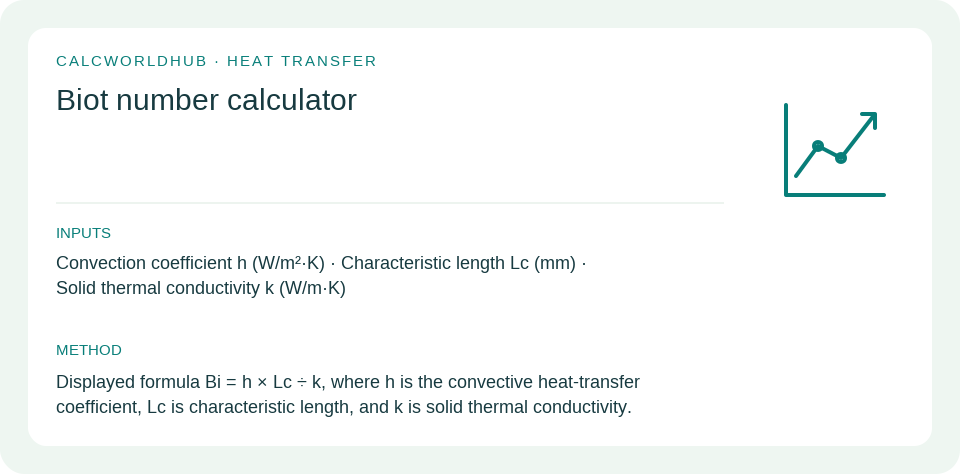
How to use this calculator
Compare internal conduction resistance with surface convection using the dimensionless Biot number.
- Enter Convection coefficient h (W/m²·K), Characteristic length Lc (mm), Solid thermal conductivity k (W/m·K). Match the units shown beside each field and review the result together with the assumptions below.
- Read the worked example below to check the expected input format and result.
- Compare another scenario by changing one input at a time. Use Reset to return to the starting values.
How this calculation works
The Biot number compares convective heat transfer at a body's surface with conduction inside the body. The characteristic length is commonly defined as volume divided by exposed surface area; use a length appropriate to the model and geometry.
Inputs and units
hCoeff— Convection coefficient h (W/m²·K)- Use a coefficient for the relevant surface and operating condition.
lcMm— Characteristic length Lc (mm)- For many bodies, use volume divided by the relevant exposed surface area.
k— Solid thermal conductivity k (W/m·K)- Use conductivity for the material and temperature range of interest.
Formula
Bi = h × Lc ÷ k, where h is the convective heat-transfer coefficient, Lc is characteristic length, and k is solid thermal conductivity.
Method
Enter h in W/(m²·K), characteristic length in millimetres, and conductivity in W/(m·K). The calculator converts millimetres to metres before forming the dimensionless ratio.
Worked example
For h = 50 W/(m²·K), Lc = 20 mm = 0.020 m, and k = 1 W/(m·K), Bi = 50 × 0.020 ÷ 1 = 1.
Assumptions and limits
The result is only a dimensionless comparison and does not calculate a temperature field. Characteristic-length choice, material properties, boundary conditions, and the validity of a lumped-capacitance model require engineering judgment.
Frequently asked questions
How do I choose the characteristic length?
Use the length defined by the heat-transfer model. Volume divided by exposed surface area is common for lumped-body analysis, but geometry and boundary conditions matter.
Does a small Biot number guarantee a uniform temperature?
It is a screening comparison, not a guarantee. Model assumptions, geometry, and the required accuracy still matter.
Why is the result dimensionless?
The units of convection coefficient times length match thermal conductivity, so their ratio has no physical unit.
How do I use the Biot number calculator?
Enter Convection coefficient h (W/m²·K), Characteristic length Lc (mm), Solid thermal conductivity k (W/m·K). Match the units shown beside each field and review the result together with the assumptions below.
What is a worked example of Biot number?
For h = 50 W/(m²·K), Lc = 20 mm = 0.020 m, and k = 1 W/(m·K), Bi = 50 × 0.020 ÷ 1 = 1.
Reference: NASA heat-transfer technical report. See our calculation methodology.