How to use this calculator
See how a bipolar differential pair steers its tail current as the input difference leaves the small-signal region.
- Enter Tail current (A), Differential base voltage (V), Junction temperature (K), Each collector load (ohm). Match the units shown beside each field and review the result together with the assumptions below.
- Read the worked example below to check the expected input format and result.
- Compare another scenario by changing one input at a time. Use Reset to return to the starting values.
BJT differential-pair current steering explained
A numerical walkthrough
Tail current (A) = 0.002; Differential base voltage (V) = 0.02; Junction temperature (K) = 300; Each collector load (ohm) = 2200.
- First collector current: 0.001369 A
- Second collector current: 0.000631 A
- Differential collector output: -1.621898 V
At 300 K a 20 mV differential input steers a 2 mA tail unequally, producing a nonlinear differential voltage across equal 2.2 kohm loads.
The model behind the numbers
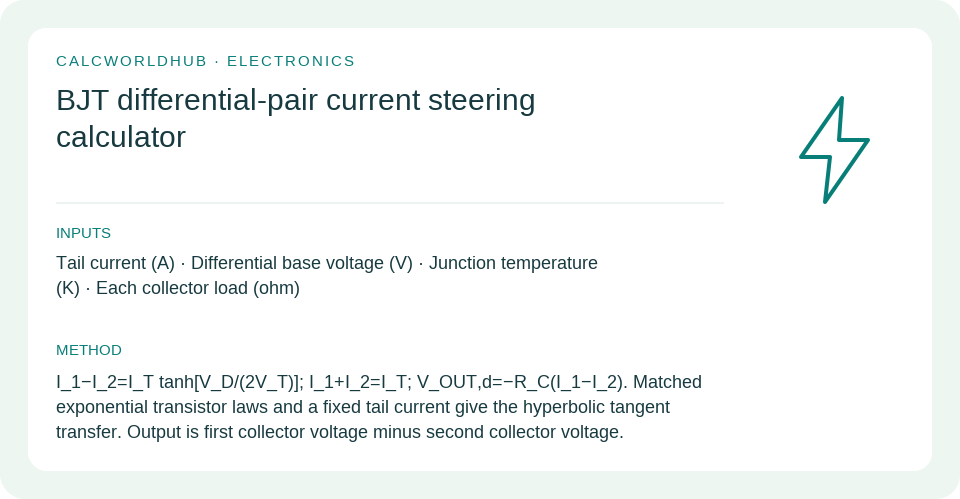
I_1−I_2=I_T tanh[V_D/(2V_T)]; I_1+I_2=I_T; V_OUT,d=−R_C(I_1−I_2).
Matched exponential transistor laws and a fixed tail current give the hyperbolic tangent transfer. Output is first collector voltage minus second collector voltage.
What to enter
It— Tail current (A)- Total ideal tail current shared by the pair.
Vd— Differential base voltage (V)- First base voltage minus second base voltage.
T— Junction temperature (K)- Shared absolute transistor temperature.
Rc— Each collector load (ohm)- Matched collector load resistors.
Interpreting the result
No emitter degeneration, base-current loading, collector saturation, mismatch or finite tail-source compliance.
Reading the outputs
Collector currents sum to the tail current. The signed differential output inverts the signed base input.
Frequently asked questions
Why does current never exceed the tail current?
The ideal tail source fixes the sum while the input redistributes it.
When is the transfer approximately linear?
When the input difference is small compared with twice the thermal voltage.
Can I infer each absolute collector voltage?
Only after adding the collector supply and checking active-region headroom.
How do I use the BJT differential-pair current steering calculator?
Enter Tail current (A), Differential base voltage (V), Junction temperature (K), Each collector load (ohm). Match the units shown beside each field and review the result together with the assumptions below.
What is a worked example of BJT differential-pair current steering?
Tail current (A) = 0.002; Differential base voltage (V) = 0.02; Junction temperature (K) = 300; Each collector load (ohm) = 2200. First collector current: 0.001369 A Second collector current: 0.000631 A Differential collector output: -1.621898 V At 300 K a 20 mV differential input steers a 2 mA tail unequally, producing a nonlinear differential voltage across equal 2.2 kohm loads.
Background or definition reference: Analog Devices Chapter 12: differential amplifiers.
Read our calculation methodology.