How to use this calculator
Compare five-day biochemical oxygen demand with chemical oxygen demand from the same wastewater sample.
- Enter BOD₅ concentration (mg/L), COD concentration (mg/L). Match the units shown beside each field and review the result together with the assumptions below.
- Read the worked example below to check the expected input format and result.
- Compare another scenario by changing one input at a time. Use Reset to return to the starting values.
How this calculation works
The BOD₅-to-COD ratio places biological oxygen demand beside a broader chemical oxygen demand measurement. Analysts use the paired results to characterize a wastewater sample and compare changes in treatment or pretreatment; the ratio is not a stand-alone pass/fail measure.
Inputs and units
bod5MgL— BOD₅ concentration (mg/L)- Five-day biochemical oxygen demand from the sample.
codMgL— COD concentration (mg/L)- Chemical oxygen demand for the same sample and matching concentration units.
Formula
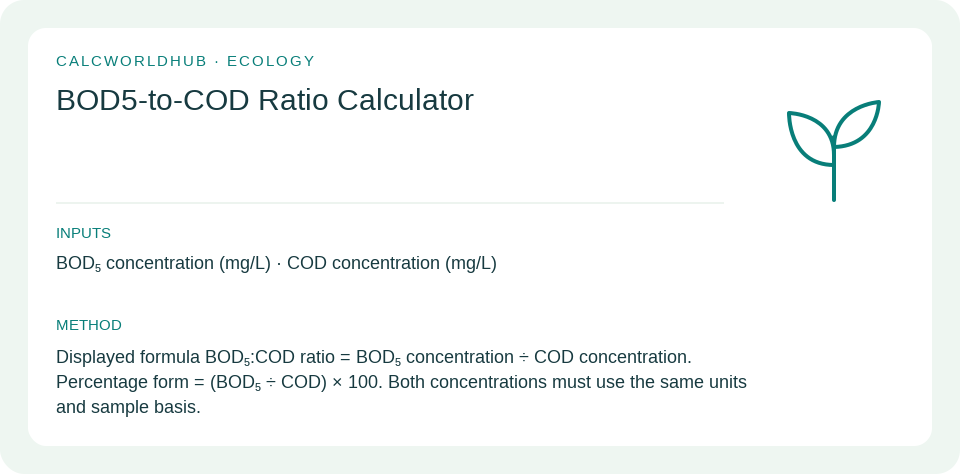
BOD₅:COD ratio = BOD₅ concentration ÷ COD concentration. Percentage form = (BOD₅ ÷ COD) × 100. Both concentrations must use the same units and sample basis.
Method
Enter paired concentrations, typically in mg/L, from the same sample and comparable dilution/reporting basis. The output includes the dimensionless BOD₅/COD ratio and its percentage form.
Worked example
For BOD₅ = 210 mg/L and COD = 500 mg/L, the ratio is 210/500 = 0.42, or 42%. The quotient is dimensionless because the concentrations use the same unit.
Assumptions and limits
BOD₅ and COD measure different analytical properties and may vary with wastewater composition and test conditions. Do not apply a universal biodegradability threshold: EPA design guidance notes that measured ratios vary by wastewater and are most useful when data are collected consistently for the specific stream.
Frequently asked questions
Do BOD₅ and COD need the same units?
Yes. Convert both results to the same concentration unit, such as mg/L, before calculating the ratio.
Should the ratio be written BOD₅/COD or COD/BOD₅?
This page reports BOD₅/COD. Some reports use the reciprocal COD/BOD₅, so check the convention before comparing values.
Does a higher ratio prove that wastewater is biodegradable?
No. It is a characterization indicator, not a universal classification rule. Sample composition, analytical method, and treatment context matter.
Can I compare BOD₅ and COD from different samples?
For a useful ratio, use measurements representative of the same wastewater sample and comparable collection and dilution conditions.
How do I use the BOD5-to-COD Ratio Calculator?
Enter BOD₅ concentration (mg/L), COD concentration (mg/L). Match the units shown beside each field and review the result together with the assumptions below.
Reference: U.S. EPA Nutrient Control Design Manual guidance on wastewater BOD and COD ratios. See our calculation methodology.