How to use this calculator
Estimate a fixed-coupon bond’s convexity and second-order price response to a user-entered yield shock.
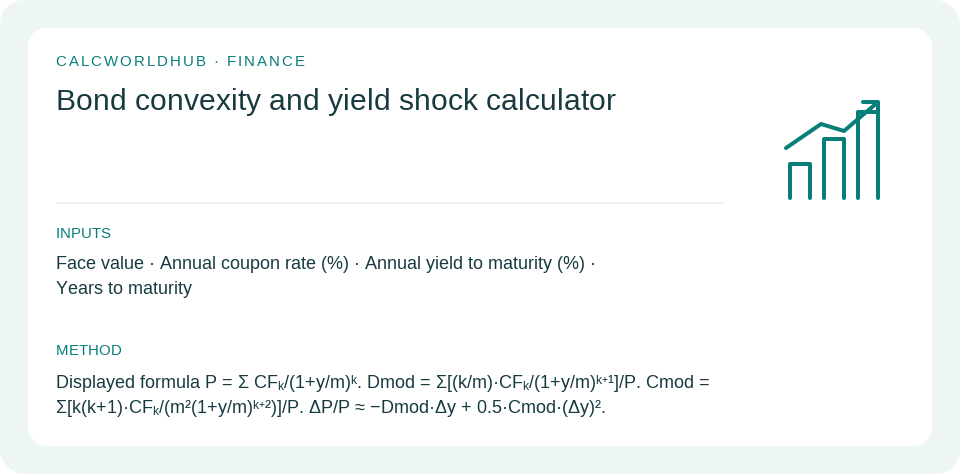
- Enter Face value, Annual coupon rate (%), Annual yield to maturity (%), Years to maturity, then complete the remaining labeled fields. Match the units shown beside each field and review the result together with the assumptions below.
- Read the worked example below to check the expected input format and result.
- Compare another scenario by changing one input at a time. Use Reset to return to the starting values.
How this calculation works
Modified duration gives a first-order estimate of bond price sensitivity. Convexity adds the curvature term, which can improve a small-shock estimate when the price-yield relationship bends away from a straight line.
Inputs and units
face— Face value- Principal repaid at maturity, in any consistent currency unit.
coupon— Annual coupon rate (%)- Annual coupon as a percentage of face value.
yield— Annual yield to maturity (%)- Nominal annual yield compounded at the selected payment frequency.
years— Years to maturity- Maturity in years; years × payment frequency must be a whole number of periods.
frequency— Coupon payments per year- Whole number of coupon periods per year, commonly 1, 2, or 4.
shock— Yield change (basis points)- Positive values model a yield rise; negative values model a yield fall.
Formula
P = Σ CFₖ/(1+y/m)ᵏ. Dmod = Σ[(k/m)·CFₖ/(1+y/m)ᵏ⁺¹]/P. Cmod = Σ[k(k+1)·CFₖ/(m²(1+y/m)ᵏ⁺²)]/P. ΔP/P ≈ −Dmod·Δy + 0.5·Cmod·(Δy)².
Method
Enter face value, annual coupon rate, annual yield, maturity, coupon frequency, and a yield change in basis points. The tool discounts level coupon cash flows and final principal using periodic compounding, then applies the duration-plus-convexity approximation.
Worked example
For face value 1,000, a 5% annual coupon, 4% annual yield, three years to maturity, and semiannual coupons, the model price is 1,028.01. Modified duration is 2.7704 and convexity is 9.3134; a +50 bp shock gives an estimated 1.3736% price decline, to about 1,013.89.
Assumptions and limits
This is a non-callable fixed-cash-flow bond with regular payment dates and a flat yield change. The price-change estimate is local; large shocks, embedded options, credit changes, taxes, and irregular accrual require a fuller valuation model.
Frequently asked questions
What does bond convexity add to duration?
Duration approximates the local linear price response; convexity adds a second-order curvature adjustment for the yield shock.
Does a positive yield shock mean the bond price rises?
No. The first-order duration effect usually lowers the estimated price when yield rises; convexity adjusts the size of that estimate.
Can I use this for a callable bond?
Not reliably. A call option can change expected cash flows as rates move, so effective duration and convexity are generally more appropriate.
How do I use the Bond convexity and yield shock calculator?
Enter Face value, Annual coupon rate (%), Annual yield to maturity (%), Years to maturity, then complete the remaining labeled fields. Match the units shown beside each field and review the result together with the assumptions below.
What is a worked example of Bond convexity and yield shock?
For face value 1,000, a 5% annual coupon, 4% annual yield, three years to maturity, and semiannual coupons, the model price is 1,028.01. Modified duration is 2.7704 and convexity is 9.3134; a +50 bp shock gives an estimated 1.3736% price decline, to about 1,013.89.
Reference: CFA Institute bond convexity and price-sensitivity reading. See our calculation methodology.