How to use this calculator
Size a boost output capacitor for its pulsed current burden and separate charge-discharge ripple from ESR steps.
- Enter Input voltage (V), Output voltage (V), Output load current (A), Switching frequency (Hz), then complete the remaining labeled fields. Match the units shown beside each field and review the result together with the assumptions below.
- Read the worked example below to check the expected input format and result.
- Compare another scenario by changing one input at a time. Use Reset to return to the starting values.
Boost output capacitor RMS current and ripple explained
In a steady continuous-conduction boost converter, the output capacitor supplies part of the load current during each switching cycle. This estimate uses the entered input/output voltages, load, frequency, capacitance, and ESR for RMS current and ripple; it omits switching transients and layout parasitics.
Inputs, symbols, and units
Vin— Input voltage (V)- Ideal boost input voltage.
Vo— Output voltage (V)- Regulated output above input voltage.
Io— Output load current (A)- Approximately constant output current.
fs— Switching frequency (Hz)- Switching cycles per second.
Co— Output capacitance (F)- Effective output capacitor value at DC bias.
ESR— Output capacitor ESR (ohm)- Series resistance at switching frequency.
Formula and method
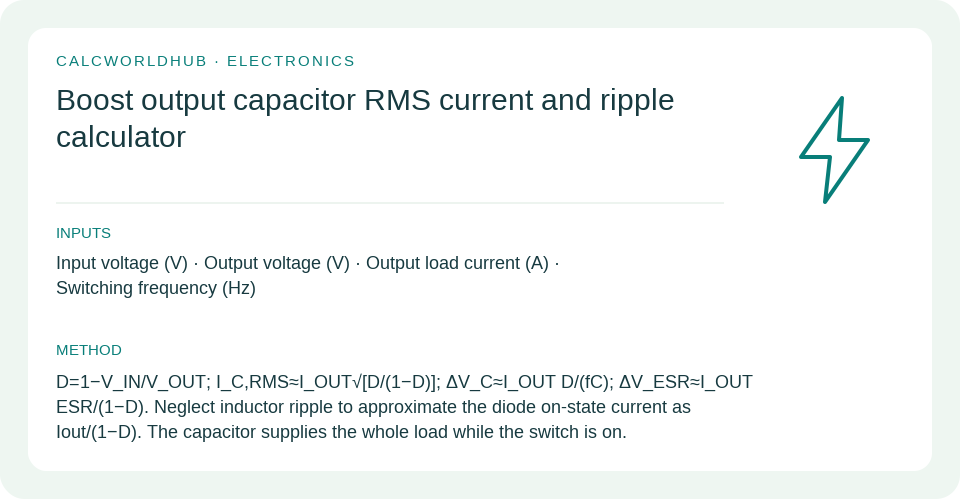
D=1−V_IN/V_OUT; I_C,RMS≈I_OUT√[D/(1−D)]; ΔV_C≈I_OUT D/(fC); ΔV_ESR≈I_OUT ESR/(1−D).
Neglect inductor ripple to approximate the diode on-state current as Iout/(1−D). The capacitor supplies the whole load while the switch is on.
A worked scenario
Input voltage (V) = 12; Output voltage (V) = 24; Output load current (A) = 1; Switching frequency (Hz) = 100000; Output capacitance (F) = 0.0001; Output capacitor ESR (ohm) = 0.03.
- Capacitor RMS current: 1 A
- Capacitive ripple: 0.05 V peak-to-peak
- ESR switching-step ripple: 0.06 V
Boosting 12 V to 24 V at 1 A uses duty 0.5; a 100 microfarad, 30 milliohm output capacitor then sees about 1 A RMS in this approximation.
Assumptions and edge cases
Ideal CCM boost, small output ripple, negligible inductor ripple. No DCM, transient-load sag or capacitor ESL ringing.
Reading the outputs
Capacitive ripple and ESR step are separate contributors; their exact waveform peak-to-peak sum depends on timing and inductor ripple.
Frequently asked questions
Why can capacitor RMS current equal load current?
The capacitor alternates between supplying the load and accepting larger pulsed diode current.
Can I combine ESR and capacitive ripple as RMS voltages?
These are waveform peak-to-peak/step estimates, not independent random RMS noises.
Does larger C reduce ESR steps?
Not directly; ESR must also be reduced or paralleled appropriately.
How do I use the Boost output capacitor RMS current and ripple calculator?
Enter Input voltage (V), Output voltage (V), Output load current (A), Switching frequency (Hz), then complete the remaining labeled fields. Match the units shown beside each field and review the result together with the assumptions below.
What is a worked example of Boost output capacitor RMS current and ripple?
Input voltage (V) = 12; Output voltage (V) = 24; Output load current (A) = 1; Switching frequency (Hz) = 100000; Output capacitance (F) = 0.0001; Output capacitor ESR (ohm) = 0.03. Capacitor RMS current: 1 A Capacitive ripple: 0.05 V peak-to-peak ESR switching-step ripple: 0.06 V Boosting 12 V to 24 V at 1 A uses duty 0.5; a 100 microfarad, 30 milliohm output capacitor then sees about 1 A RMS in this approximation.
Background or definition reference: Texas Instruments SLVA372D: boost power-stage capacitor selection.
Read our calculation methodology.