How to use this calculator
Translate capacitor ripple current into internal dissipation and a steady core-temperature estimate.
- Enter Ripple RMS current (A), Equivalent series resistance (ohm), Core-to-ambient thermal resistance (K/W), Ambient temperature (deg C), then complete the remaining labeled fields. Match the units shown beside each field and review the result together with the assumptions below.
- Read the worked example below to check the expected input format and result.
- Compare another scenario by changing one input at a time. Use Reset to return to the starting values.
Capacitor ESR ripple heating budget explained
Ripple-current heating is I_RMS² × ESR; multiplying that loss by thermal resistance estimates the steady core-temperature rise above ambient. The current limit solves backward from the entered maximum core temperature.
Inputs, symbols, and units
I— Ripple RMS current (A)- True RMS alternating current at the frequency used for ESR.
ESR— Equivalent series resistance (ohm)- ESR at the relevant ripple frequency and temperature.
Rth— Core-to-ambient thermal resistance (K/W)- Thermal resistance of capacitor in its installed conditions.
Ta— Ambient temperature (deg C)- Local air or mounting ambient temperature.
Tmax— Permitted capacitor core temperature (deg C)- Maximum core temperature for this estimate.
Formula and method
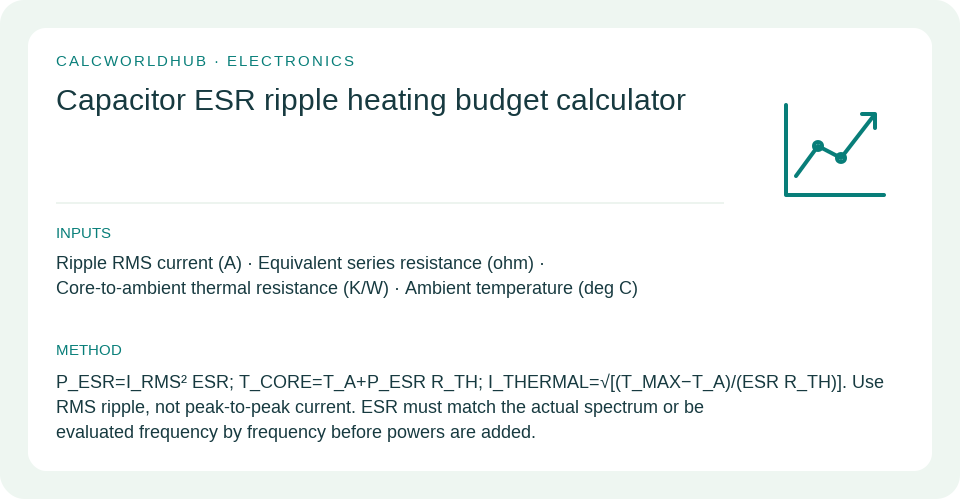
P_ESR=I_RMS² ESR; T_CORE=T_A+P_ESR R_TH; I_THERMAL=√[(T_MAX−T_A)/(ESR R_TH)].
Use RMS ripple, not peak-to-peak current. ESR must match the actual spectrum or be evaluated frequency by frequency before powers are added.
A worked scenario
Ripple RMS current (A) = 1.5; Equivalent series resistance (ohm) = 0.08; Core-to-ambient thermal resistance (K/W) = 18; Ambient temperature (deg C) = 45; Permitted capacitor core temperature (deg C) = 105.
- Estimated core temperature: 48.24 deg C
- Ripple heating: 0.18 W
- Thermal ripple-current limit: 6.454972 A RMS
A 1.5 A RMS ripple through 0.08 ohm ESR dissipates 0.18 W; with 18 K/W thermal resistance the core rises 3.24 K above 45 °C.
Assumptions and edge cases
Single steady thermal resistance and constant ESR. Does not predict lifetime, hotspot distribution or runaway feedback.
Reading the outputs
The thermal current limit ignores independent manufacturer ripple-rating, voltage and lifetime limits; use the smallest applicable limit.
Frequently asked questions
Can I use switching-current peak-to-peak as RMS?
No. Convert the actual waveform to RMS first.
Why does frequency matter?
Capacitor ESR and permitted ripple current generally vary with frequency.
Does a low core temperature guarantee long life?
No. Voltage stress, chemistry and manufacturer lifetime models also matter.
How do I use the Capacitor ESR ripple heating budget calculator?
Enter Ripple RMS current (A), Equivalent series resistance (ohm), Core-to-ambient thermal resistance (K/W), Ambient temperature (deg C), then complete the remaining labeled fields. Match the units shown beside each field and review the result together with the assumptions below.
What is a worked example of Capacitor ESR ripple heating budget?
Ripple RMS current (A) = 1.5; Equivalent series resistance (ohm) = 0.08; Core-to-ambient thermal resistance (K/W) = 18; Ambient temperature (deg C) = 45; Permitted capacitor core temperature (deg C) = 105. Estimated core temperature: 48.24 deg C Ripple heating: 0.18 W Thermal ripple-current limit: 6.454972 A RMS A 1.5 A RMS ripple through 0.08 ohm ESR dissipates 0.18 W; with 18 K/W thermal resistance the core rises 3.24 K above 45 °C.
Background or definition reference: Texas Instruments thermal dynamics.
Read our calculation methodology.