How to use this calculator
Separate deterministic held-voltage error from sampling thermal noise when choosing a hold capacitor and hold interval.
- Enter Hold capacitance (F), Total signed leakage (A), Hold interval (s), Injected charge (C), then complete the remaining labeled fields. Match the units shown beside each field and review the result together with the assumptions below.
- Read the worked example below to check the expected input format and result.
- Compare another scenario by changing one input at a time. Use Reset to return to the starting values.
Sample-and-hold droop and kT over C noise explained
Separate signed held-voltage change from leakage and injected charge, and estimate the capacitor’s thermal-noise voltage.
How the calculation works
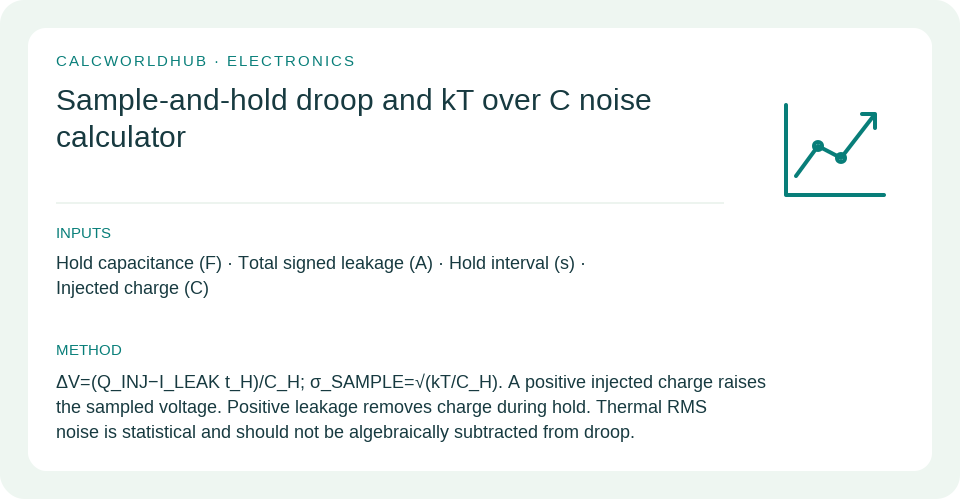
ΔV=(Q_INJ−I_LEAK t_H)/C_H; σ_SAMPLE=√(kT/C_H).
A positive injected charge raises the sampled voltage. Positive leakage removes charge during hold. Thermal RMS noise is statistical and should not be algebraically subtracted from droop.
Set up the calculation
C— Hold capacitance (F)- Capacitance isolated during hold.
I— Total signed leakage (A)- Net leakage discharging a positive held voltage; may be negative.
t— Hold interval (s)- Time with the capacitor isolated.
Qinj— Injected charge (C)- Signed switch charge added when hold starts.
T— Temperature (K)- Absolute switching network temperature.
Limits of this model
Constant leakage, ideal acquisition and no dielectric absorption. kT/C assumes an equilibrated resistive sampling switch.
Check this example
Hold capacitance (F) = 1.00000000e-09; Total signed leakage (A) = 1.00000000e-09; Hold interval (s) = 0.001; Injected charge (C) = 1.00000000e-12; Temperature (K) = 300.
- Held-voltage error: -2.01948392e-19 V
- Leakage droop: 0.001 V
- Sampling thermal RMS noise: 0.000002 V
A 1 nF capacitor loses 1 mV from 1 nA leakage over 1 ms; 1 pC charge injection raises it by the same nominal amount without removing sampling noise.
Reading the outputs
Held-voltage error is signed. Leakage droop is shown separately, and thermal noise is one-sigma RMS volts.
Frequently asked questions
Does cancellation of droop and injection guarantee accuracy?
No; both vary with voltage and temperature, and random sampling noise remains.
Why does larger capacitance reduce noise?
Thermal charge variance scales with C, so voltage variance is kT/C.
Is the leakage current just the capacitor leakage?
Include switch, amplifier input and board leakage with their actual signs.
How do I use the Sample-and-hold droop and kT over C noise calculator?
Enter Hold capacitance (F), Total signed leakage (A), Hold interval (s), Injected charge (C), then complete the remaining labeled fields. Match the units shown beside each field and review the result together with the assumptions below.
What is a worked example of Sample-and-hold droop and kT over C noise?
Hold capacitance (F) = 1.00000000e-09; Total signed leakage (A) = 1.00000000e-09; Hold interval (s) = 0.001; Injected charge (C) = 1.00000000e-12; Temperature (K) = 300. Held-voltage error: -2.01948392e-19 V Leakage droop: 0.001 V Sampling thermal RMS noise: 0.000002 V A 1 nF capacitor loses 1 mV from 1 nA leakage over 1 ms; 1 pC charge injection raises it by the same nominal amount without removing sampling noise.
Background or definition reference: Analog Devices sampled-data thermal noise.