Capacitor charge from voltage calculator
Calculate the charge associated with a capacitor’s stated capacitance and voltage.
inputs.
Calculator
How to use this calculator
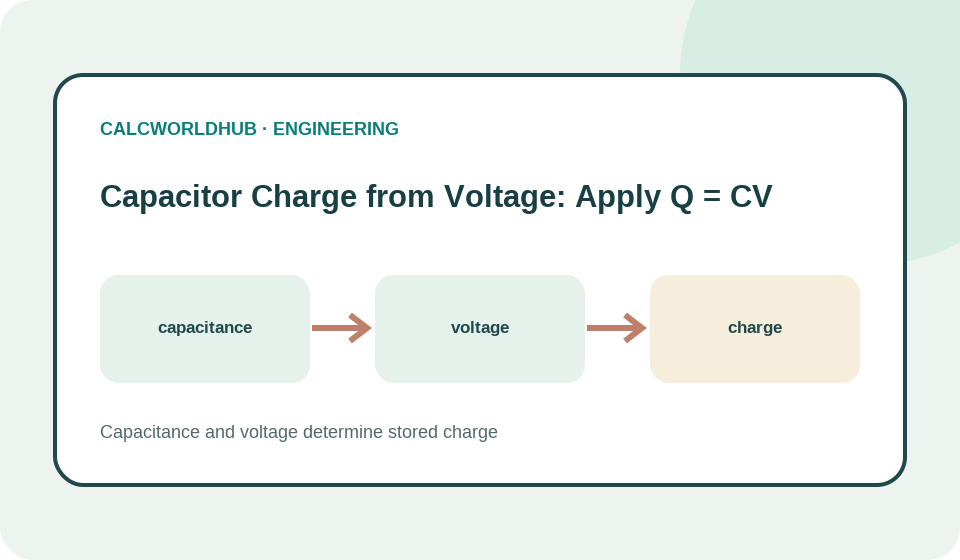
Calculate capacitor charge from capacitance and voltage using Q = C × V.
- Enter Capacitance (F), Voltage (V). Match the units shown beside each field and review the result together with the assumptions below.
- Read the worked example below to check the expected input format and result.
- Compare another scenario by changing one input at a time. Use Reset to return to the starting values.
Find stored charge from capacitance and voltage
For a capacitor at a stated voltage, charge is the product of capacitance and voltage. This calculation describes the static charge magnitude; it does not model how quickly an RC circuit reaches that voltage.
Inputs and units
- Capacitance (F): Capacitance in farads; microfarads must be converted to farads before entering.
- Voltage (V): Potential difference across the capacitor in volts.
Formula and method
Q = C × V. A farad multiplied by a volt gives a coulomb. Resistance and elapsed charging time are not needed once the capacitor voltage is specified, so those former fields have been removed.
Worked example
With C = 10 μF = 0.00001 F and V = 5 V, Q = 0.00001 × 5 = 0.00005 C, or 50 μC.
Interpreting the result
The result is the charge magnitude associated with the entered capacitance and voltage. It does not describe stored energy, leakage, a transient waveform, or the voltage rating of the capacitor.
Assumptions and limits
This uses the ideal linear relation Q = CV. For time-dependent charging through a resistor, use an RC transient model and specify the initial condition and circuit topology.
Method references
Frequently asked questions
How do resistance and time affect the charge?
They determine how a capacitor approaches its final voltage in a transient circuit. If the voltage across the capacitor is already specified, Q = CV does not require resistance or elapsed time.
How do I use the Capacitor charge from voltage calculator?
Enter Capacitance (F), Voltage (V). Match the units shown beside each field and review the result together with the assumptions below.
What is a worked example of Capacitor charge from voltage?
With C = 10 μF = 0.00001 F and V = 5 V, Q = 0.00001 × 5 = 0.00005 C, or 50 μC.
What does the Capacitor charge from voltage calculator calculate?
Calculate capacitor charge from capacitance and voltage using Q = C × V.
What assumptions apply to Capacitor charge from voltage?
This uses the ideal linear relation Q = CV. For time-dependent charging through a resistor, use an RC transient model and specify the initial condition and circuit topology.
Good calculators show their work.
CalcWorldHub is built around clear inputs and visible assumptions. Results are estimates for planning; check official sources or your provider’s terms when exact figures matter.