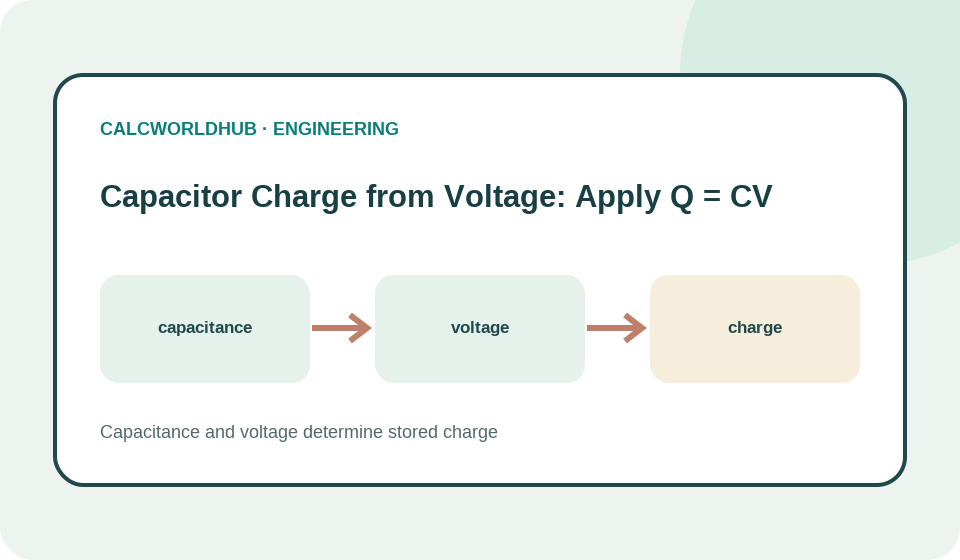

Relate stored charge to voltage
Capacitance describes how much charge is stored per unit voltage under a stated condition. The charge Q is the magnitude of charge on one plate, and V is the potential difference across the capacitor. In a circuit, identify the actual capacitor and voltage point before entering values; a supply voltage is not automatically the same as the instantaneous voltage across every component.
Convert capacitance and voltage inputs
The calculator accepts capacitance in microfarads and voltage in volts, then returns charge in coulombs. Convert microfarads to farads by multiplying by 10⁻⁶ before applying the SI equation. Keep the unit conversion visible in a hand check, because multiplying a raw number of microfarads by volts without conversion produces microcoulombs rather than coulombs.
Use the linear charge relation
For a linear capacitor, Q = C V. The relationship follows from the definition of capacitance and is the usual ideal component model. A higher capacitance or a higher voltage increases charge proportionally when the other input is fixed. The equation is not a time-domain model: it describes charge at a voltage, not the current or time required to reach it.
Distinguish charge from energy
Charge and energy are related but not interchangeable. Energy stored in an ideal capacitor is ½CV², while charge is CV. The voltage appears squared in the energy expression, so doubling voltage doubles charge but quadruples stored energy. Use the output only for charge-related calculations and apply the appropriate separate equation for energy or circuit dynamics.
Apply the estimate to a component
This estimate can help check a component datasheet, compare designs, or verify an introductory circuit calculation. Real capacitors have tolerances, leakage, voltage ratings, temperature effects, and dielectric behavior. If the input is a nominal value, the output inherits that tolerance; the calculator presents a single nominal result rather than a range.
For consistency, write the input pair beside the result: capacitance in farads and voltage in volts produce coulombs. A charge value without that context can be mistaken for a current or for a charge transferred over time. If using the result in another equation, carry the unrounded charge internally and round only when matching the precision of the component data or measurement.
In a measurement setup, charge transferred during a known interval can also be found by integrating current over time. That approach answers a different question from Q = CV: it uses an observed current history rather than a capacitance and voltage pair. If the two estimates are compared, align the measurement interval, leakage, and capacitor voltage state; a mismatch may reveal an unmodeled current path or a measurement offset.
Worked examples
Capacitance is converted from microfarads to farads before multiplying by the voltage.
A small capacitor at twelve volts
Inputs: Capacitance C = 10 μF = 10×10⁻⁶ F; voltage V = 12 V.
Calculation: Q = CV = (10×10⁻⁶ F)(12 V) = 120×10⁻⁶ C = 0.000120 C.
The ideal charge magnitude is 1.20×10⁻⁴ coulombs.
A larger capacitance at five volts
Inputs: Capacitance C = 470 μF = 470×10⁻⁶ F; voltage V = 5 V.
Calculation: Q = CV = (470×10⁻⁶)(5) = 2,350×10⁻⁶ C = 0.002350 C.
The ideal stored charge is 2.35×10⁻³ coulombs.

Assumptions behind Q equals CV
The voltage should be the voltage across the capacitor at the condition of interest. In an AC circuit, that voltage may vary with time, and the simple calculator does not model phase, frequency, charging current, or ripple. For a switching or transient design, use a circuit model and the component manufacturer’s rating rather than treating a static Q value as a complete design check.
The ideal equation is most direct for a linear capacitor with a stable capacitance over the operating range. Some devices are voltage- or temperature-dependent, and series or parallel networks require first finding the effective capacitance seen at the terminals. This tool calculates the charge for one entered capacitance; it does not combine a circuit network automatically.