How to use this calculator
Estimate ideal rotor temperature rise from vehicle kinetic energy and the share absorbed by selected rotors.
- Enter Vehicle mass (kg), Initial speed (km/h), Energy share absorbed by modeled rotors (%), Number of modeled rotors, then complete the remaining labeled fields. Match the units shown beside each field and review the result together with the assumptions below.
- Read the worked example below to check the expected input format and result.
- Compare another scenario by changing one input at a time. Use Reset to return to the starting values.
Brake rotor temperature rise from one stop explained
This one-stop energy balance converts vehicle kinetic energy into a lumped rotor temperature rise using the selected energy share, rotor count, rotor mass, and heat capacity.
A numerical walkthrough
Vehicle mass (kg) = 1500; Initial speed (km/h) = 100; Energy share absorbed by modeled rotors (%) = 70; Number of modeled rotors = 2; Mass per rotor (kg) = 7; Rotor specific heat (J/kg/K) = 500.
- Kinetic energy before stop: 578703.703704 J
- Energy assigned to modeled rotors: 405092.592593 J
- Ideal rotor temperature rise: 57.87037 K
- Energy per rotor: 202546.296296 J
A 1,500 kg vehicle at 100 km/h has about 579 kJ kinetic energy. Assigning 70% across two 7 kg rotors gives an ideal rise of about 58 K.
The model behind the numbers
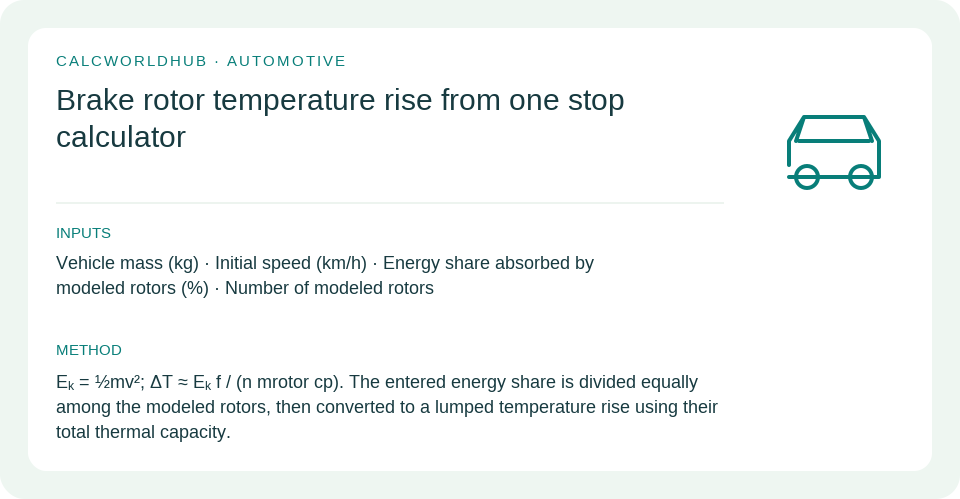
Eₖ = ½mv²; ΔT ≈ Eₖ f / (n mrotor cp).
The entered energy share is divided equally among the modeled rotors, then converted to a lumped temperature rise using their total thermal capacity.
What to enter
mass— Vehicle mass (kg)- Mass before braking.
speed— Initial speed (km/h)- Vehicle speed before the stop.
share— Energy share absorbed by modeled rotors (%)- Fraction of vehicle kinetic energy assigned to the selected rotor group.
rotors— Number of modeled rotors- Rotors sharing the entered energy fraction. Enter a whole number.
rotorMass— Mass per rotor (kg)- Thermally active rotor mass per unit.
cp— Rotor specific heat (J/kg/K)- Effective specific heat over the temperature interval.
Interpreting the result
A single stop with uniform rotor temperature is assumed. Pads, tires, wheels, airflow, repeated braking, and front/rear bias are not resolved.
Reading the outputs
The page reports whole-vehicle kinetic energy, energy assigned to the rotor group, energy per rotor, and the lumped temperature rise. That rise is an ideal energy-capacity estimate, not a measured rotor temperature.
Frequently asked questions
How does initial speed affect the estimate?
Kinetic energy scales with speed squared, so a 10% speed increase raises pre-stop energy by 21% when the other inputs stay fixed.
How is the selected energy share applied?
The entered share of vehicle kinetic energy is divided equally across the modeled rotors, then divided by their combined heat capacity.
Which real braking effects are outside this one-stop estimate?
The model assumes one stop and a uniform rotor temperature; pads, tires, wheels, airflow, repeat stops, and front/rear bias are not resolved.
How do I use the Brake rotor temperature rise from one stop calculator?
Enter Vehicle mass (kg), Initial speed (km/h), Energy share absorbed by modeled rotors (%), Number of modeled rotors, then complete the remaining labeled fields. Match the units shown beside each field and review the result together with the assumptions below.
What is a worked example of Brake rotor temperature rise from one stop?
Vehicle mass (kg) = 1500; Initial speed (km/h) = 100; Energy share absorbed by modeled rotors (%) = 70; Number of modeled rotors = 2; Mass per rotor (kg) = 7; Rotor specific heat (J/kg/K) = 500. Kinetic energy before stop: 578703.703704 J Energy assigned to modeled rotors: 405092.592593 J Ideal rotor temperature rise: 57.87037 K Energy per rotor: 202546.296296 J A 1,500 kg vehicle at 100 km/h has about 579 kJ kinetic energy. Assigning 70% across two 7 kg rotors gives an ideal rise of about 58 K.
Read our calculation methodology.