Ideal braking distance calculator
Estimate ideal friction-limited braking distance from speed and tire-road friction.
Related calculators and articles
Compare methods and explore more free tools in automotive.
How to use this calculator
Estimate ideal friction-limited braking distance from speed and tire-road friction.
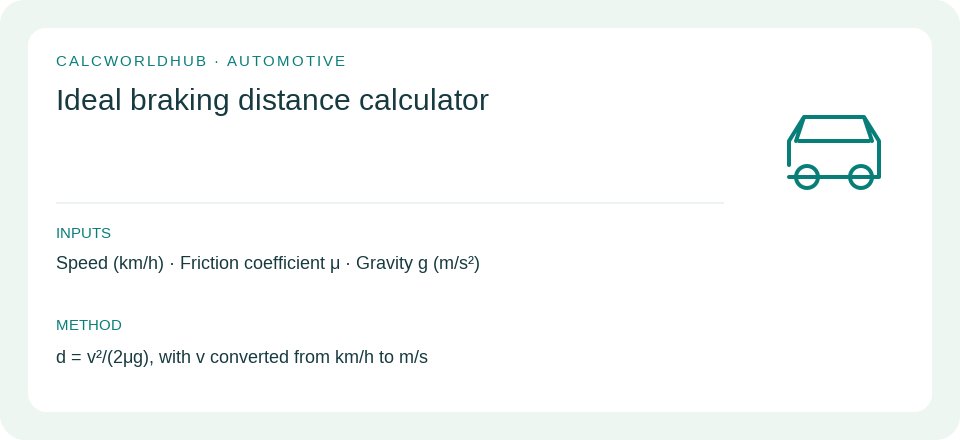
- Enter Speed (km/h), Friction coefficient μ, Gravity g (m/s²). Match the units shown beside each field and review the result together with the assumptions below.
- Read the worked example below to check the expected input format and result.
- Compare another scenario by changing one input at a time. Use Reset to return to the starting values.
Ideal braking distance calculator
Estimate ideal friction-limited braking distance from speed and tire-road friction.
Inputs and units
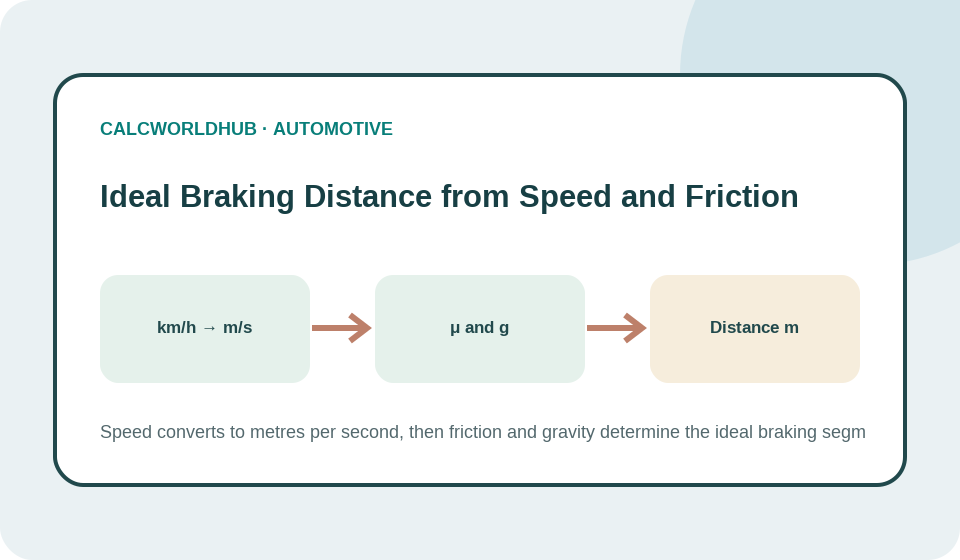
- Speed (km/h): Initial road speed; the calculator converts km/h to m/s before squaring it in the friction stopping-distance equation.
- Friction coefficient μ: Dimensionless effective tire-road friction coefficient; surface and tire conditions strongly affect it.
- Gravity g (m/s²): Positive gravitational acceleration in m/s²; use a local value when elevation or planetary context matters.
Formula and method
d = v²/(2μg), with v converted from km/h to m/s
Worked example
At 80 km/h, μ=0.70 and g=9.81 m/s², v=22.22 m/s and d≈22.22²/(2·0.70·9.81)=35.96 m.
Interpreting the result
This is braking distance after the brakes act. Add reaction distance separately for total stopping distance.
Assumptions and limits
Speed may be zero; friction coefficient and gravity must be positive. Assumes level road and constant friction; grade, tires, brakes, weather, and human reaction are excluded.
Sources and method
- Uses work done by friction to derive ideal stopping distance; this calculator excludes reaction time and road-grade effects. OpenStax Physics: nonconservative forces
Frequently asked questions
What does this ideal braking distance result tell me?
This is braking distance after the brakes act. Add reaction distance separately for total stopping distance.
What assumptions should I check?
Speed may be zero; friction coefficient and gravity must be positive. Assumes level road and constant friction; grade, tires, brakes, weather, and human reaction are excluded.
How do I use the Ideal braking distance calculator?
Enter Speed (km/h), Friction coefficient μ, Gravity g (m/s²). Match the units shown beside each field and review the result together with the assumptions below.
What is a worked example of Ideal braking distance?
At 80 km/h, μ=0.70 and g=9.81 m/s², v=22.22 m/s and d≈22.22²/(2·0.70·9.81)=35.96 m.
What does the Ideal braking distance calculator calculate?
Estimate ideal friction-limited braking distance from speed and tire-road friction.
See the calculation methodology.