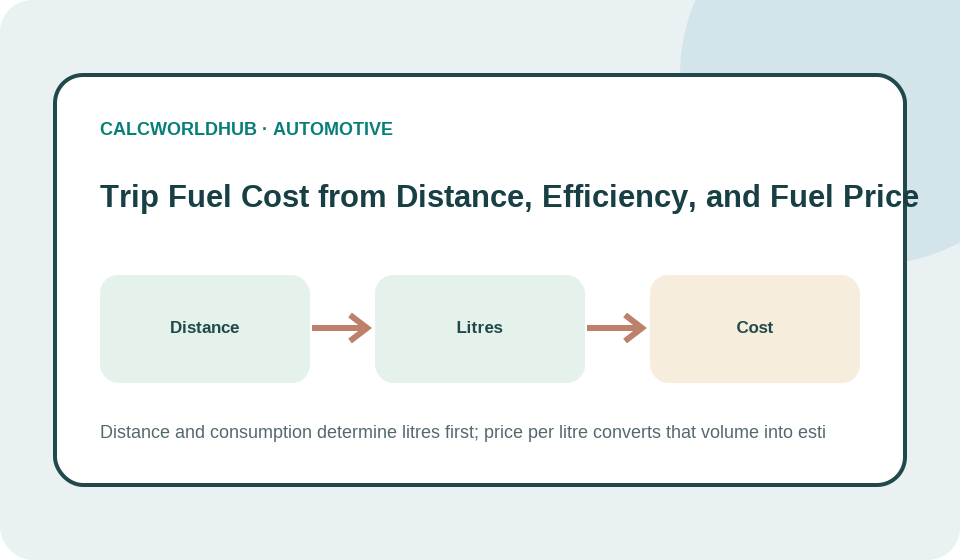

Read the three inputs on one basis
Trip distance is entered in kilometres, fuel consumption in litres per 100 kilometres, and fuel price in dollars per litre. These units are compatible: distance multiplied by L/100 km gives litres after division by 100, and litres multiplied by price per litre gives a currency amount. Changing only the currency symbol does not change the arithmetic.
Enter the distance actually being budgeted and use a consumption figure with a comparable driving mix, vehicle load, and measurement basis. An official test figure can help compare vehicles, while a fuel log may better represent a particular route. Avoid combining a highway-only distance with a city-only consumption rate unless that is the scenario you intend.
Calculate litres before currency
First estimate fuel volume: distance × consumption ÷ 100. Then multiply litres by price per litre. For 420 km at 7.5 L/100 km, estimated fuel is 31.5 L. At $1.70 per litre, the modeled cost is $53.55. Keeping the volume step visible helps catch an error such as multiplying by 100 instead of dividing by it.
The calculator accepts nonnegative distance, consumption, and price. If distance is zero, or if consumption or price is zero, estimated cost is zero. A negative input is not a valid trip budget. It does not apply taxes, discounts, fuel-station differences, card fees, or price changes unless those are already reflected in the entered price.
Choose a consumption rate carefully
Fuel consumption can vary with speed, traffic, temperature, terrain, tire condition, vehicle load, driving style, and engine warm-up. A single L/100 km number compresses those conditions into an average. If the route includes a long climb, towing, or cold starts, a combined published rating may understate fuel needed for that specific journey.
For a low and high budget, calculate two plausible consumption values while leaving distance and price fixed. That isolates sensitivity to driving conditions. If the route’s price will vary, use a separate price scenario rather than implying that this calculator finds a live station price or maps fuel stops.
Interpret the cost as a trip estimate
The result is an estimated fuel expense for the entered distance and rate. It is not total vehicle cost: tolls, parking, maintenance, depreciation, insurance, charging, and passenger sharing are outside the model. A displayed cents value is a rounded final cost, so retain full precision in the litres calculation before rounding the currency total.
When comparing routes, keep the vehicle and price assumptions consistent and change only distance or consumption as needed. A shorter route can still use more fuel if its conditions produce a much higher average consumption. The equation allows a transparent comparison, but it does not predict traffic or determine which route is safest or quickest.
Use observed data as feedback
After a trip, compare the estimate with the volume shown on a refill record and the distance driven. A single tank may include non-route driving, idling, or a different fill level; repeated measurements give a better average. If the estimate is consistently low, update the consumption assumption rather than treating the difference as hidden calculator output.
FuelEconomy.gov describes how driving conditions and habits affect fuel economy. Use such guidance to understand why a test rating and a personal trip can differ. For a practical budget, choose a rate from comparable records, state whether it is a trip average or official rating, and keep the result tied to the date and fuel price used.
Worked examples
The first route uses the calculator defaults; the second shows how a shorter trip changes both litres and cost.
A 420 km mixed trip
Inputs: Distance = 420 km; consumption = 7.5 L/100 km; fuel price = $1.70/L.
Calculation: Fuel = 420 × 7.5 ÷ 100 = 31.5 L; cost = 31.5 × $1.70 = $53.55.
The model estimates $53.55 in fuel at the stated price. It excludes other driving expenses and assumes the entered consumption applies across the whole distance.
A shorter route at a lower consumption rate
Inputs: Distance = 250 km; consumption = 6.4 L/100 km; fuel price = $1.80/L.
Calculation: Fuel = 250 × 6.4 ÷ 100 = 16 L; cost = 16 × $1.80 = $28.80.
The estimated volume is 16 L and the modeled fuel cost is $28.80. A different route or driving pattern should use its own consumption assumption rather than borrowing this result.
