How to use this calculator
Estimate reaction distance and idealized braking distance from speed, reaction time, and road friction.
- Enter Initial speed (km/h), Reaction time (s), Effective tire-road friction coefficient μ. Match the units shown beside each field and review the result together with the assumptions below.
- Read the worked example below to check the expected input format and result.
- Compare another scenario by changing one input at a time. Use Reset to return to the starting values.
Separate reaction travel from idealized braking distance
A vehicle travels before the driver reacts, then continues moving while the brakes slow it. This calculator estimates those two components from speed, reaction time, and a supplied tire-road friction coefficient.
Inputs and units
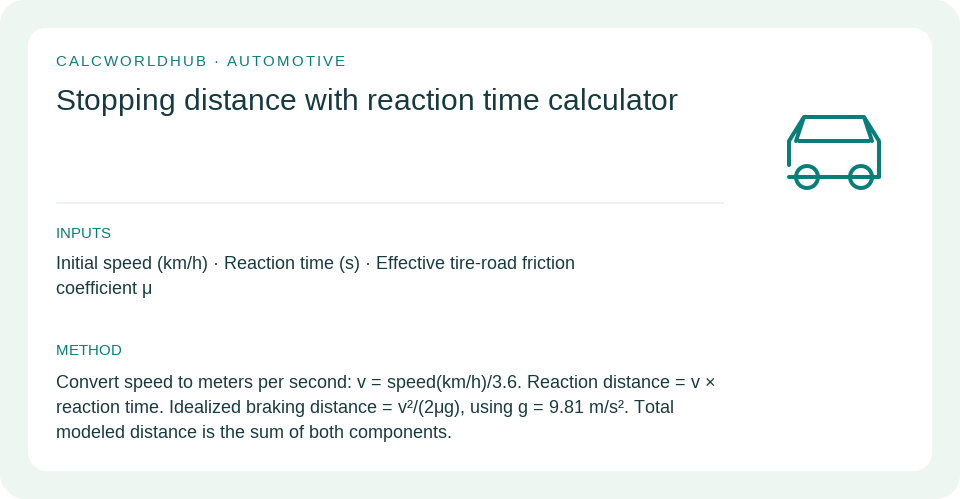
- Initial speed (km/h): Vehicle speed before the reaction interval.
- Reaction time (s): Time between detecting a hazard and applying the brakes.
- Effective tire-road friction coefficient μ: The effective friction value assumed by the braking model; it varies with tires, surface, weather, and braking conditions.
Formula and method
Convert speed to meters per second: v = speed(km/h)/3.6. Reaction distance = v × reaction time. Idealized braking distance = v²/(2μg), using g = 9.81 m/s². Total modeled distance is the sum of both components.
Worked example
At 50 km/h, v = 50/3.6 ≈ 13.8889 m/s. With 1.5 s reaction time, reaction distance is about 20.83 m. With μ = 0.7, braking distance is 13.8889²/(2×0.7×9.81) ≈ 14.05 m. The two components sum to about 34.88 m.
Interpreting the result
The estimate decomposes the modeled distance into about 20.83 m before braking and 14.05 m under the selected deceleration assumption. It is not a safe following distance or a promise that a vehicle can stop within that space.
Assumptions and limits
The braking relation assumes straight, level travel and constant deceleration tied to the entered friction coefficient. Real stopping distance changes with road grade, tire condition, brake response, surface, weather, load, perception time, and other factors. Leave extra space and follow local road-safety guidance.
Method references
Frequently asked questions
Does this include the time needed to notice a hazard?
The entered reaction time represents the interval you choose. The calculator does not measure perception time or predict a driver’s response under real conditions.
How do I use the Stopping distance with reaction time calculator?
Enter Initial speed (km/h), Reaction time (s), Effective tire-road friction coefficient μ. Match the units shown beside each field and review the result together with the assumptions below.
What is a worked example of Stopping distance with reaction time?
At 50 km/h, v = 50/3.6 ≈ 13.8889 m/s. With 1.5 s reaction time, reaction distance is about 20.83 m. With μ = 0.7, braking distance is 13.8889²/(2×0.7×9.81) ≈ 14.05 m. The two components sum to about 34.88 m.
What does the Stopping distance with reaction time calculator calculate?
Estimate reaction distance and idealized braking distance from speed, reaction time, and road friction.
What assumptions apply to Stopping distance with reaction time?
The braking relation assumes straight, level travel and constant deceleration tied to the entered friction coefficient. Real stopping distance changes with road grade, tire condition, brake response, surface, weather, load, perception time, and other factors. Leave extra space and follow local road-safety guidance.