How to use this calculator
Estimate acid-form and conjugate-base masses for a monoprotic buffer at a target pH, concentration, and final volume.
- Enter Target pH, Acid pKa, Total buffer concentration (mol/L), Final solution volume (L), then complete the remaining labeled fields. Match the units shown beside each field and review the result together with the assumptions below.
- Read the worked example below to check the expected input format and result.
- Compare another scenario by changing one input at a time. Use Reset to return to the starting values.
How this calculation works
The Henderson–Hasselbalch relationship sets the conjugate-base-to-acid mole ratio needed for a target pH. Combining that ratio with total buffer concentration and final volume gives the moles and weighed masses of both forms for an ideal monoprotic buffer.
Inputs and units
targetPh— Target pH- Desired final pH.
pKa— Acid pKa- pKa appropriate to the working temperature and medium.
totalConcentration— Total buffer concentration (mol/L)- Sum of acid-form and base-form molar concentrations.
finalVolume— Final solution volume (L)- Final volume after dissolving and making up to mark.
acidMolarMass— Acid-form molar mass (g/mol)- Molar mass of the acid form being weighed.
baseMolarMass— Conjugate-base molar mass (g/mol)- Molar mass of the conjugate-base reagent form.
Formula
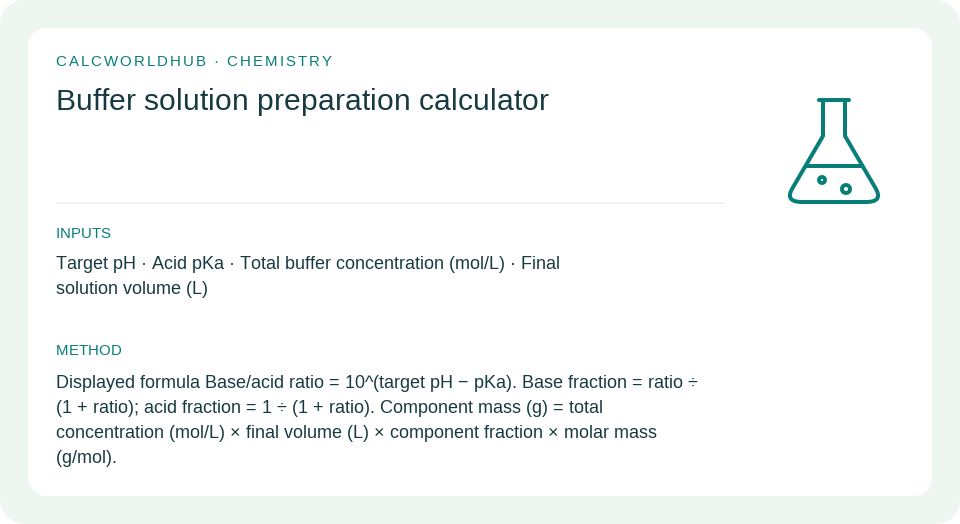
Base/acid ratio = 10^(target pH − pKa). Base fraction = ratio ÷ (1 + ratio); acid fraction = 1 ÷ (1 + ratio). Component mass (g) = total concentration (mol/L) × final volume (L) × component fraction × molar mass (g/mol).
Method
Enter target pH, the acid pKa at the working temperature, desired total buffer concentration and final solution volume. Supply molar masses for the acid and conjugate-base forms you will weigh; this assumes the stated forms and does not calculate hydrate corrections.
Worked example
For pH 6.0, pKa 6.2, 0.10 mol/L total buffer, and 1.00 L, the base-to-acid ratio is 10^(−0.2) = 0.631. With molar masses 122 and 142 g/mol, the ideal mixture requires approximately 7.48 g acid form and 5.49 g conjugate-base form.
Assumptions and limits
This ideal calculation ignores activity coefficients, temperature-dependent pKa shifts, solvent effects, and volume change on mixing. Actual pH can differ, especially at higher ionic strength. Verify reagent form, purity, hydrate state, and final pH experimentally.
Frequently asked questions
Why do I need both molar masses?
The acid and conjugate-base reagents can have different chemical formulas and molar masses, so each component mass is calculated separately.
Does this guarantee the final pH?
No. It estimates a starting composition under an ideal equilibrium model; calibrate a pH meter and adjust the prepared solution as needed.
Can this handle polyprotic buffers?
This page assumes one acid dissociation pair. Polyprotic systems need species-specific equilibrium calculations.
How do I use the Buffer solution preparation calculator?
Enter Target pH, Acid pKa, Total buffer concentration (mol/L), Final solution volume (L), then complete the remaining labeled fields. Match the units shown beside each field and review the result together with the assumptions below.
What is a worked example of Buffer solution preparation?
For pH 6.0, pKa 6.2, 0.10 mol/L total buffer, and 1.00 L, the base-to-acid ratio is 10^(−0.2) = 0.631. With molar masses 122 and 142 g/mol, the ideal mixture requires approximately 7.48 g acid form and 5.49 g conjugate-base form.
Read our calculation methodology.