How to use this calculator
Estimate bulk-material conveyor mass throughput from loaded cross-section, belt speed, and material bulk density.
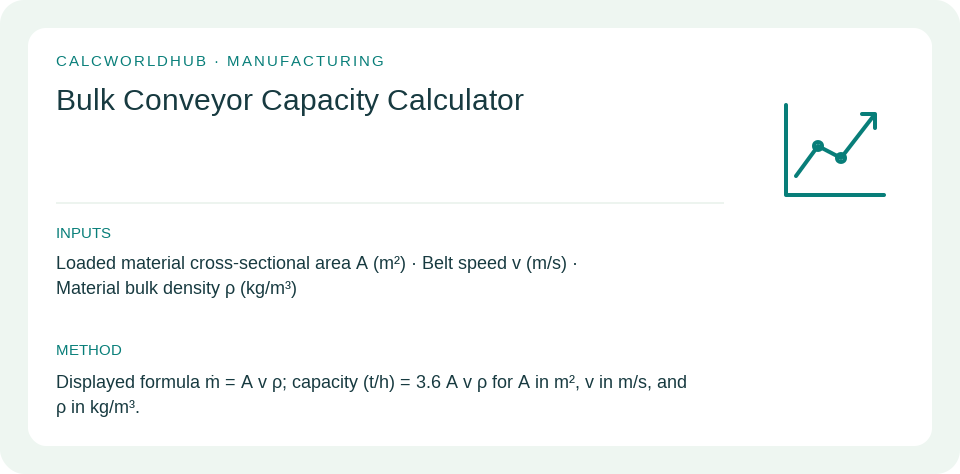
- Enter Loaded material cross-sectional area A (m²), Belt speed v (m/s), Material bulk density ρ (kg/m³). Match the units shown beside each field and review the result together with the assumptions below.
- Read the worked example below to check the expected input format and result.
- Compare another scenario by changing one input at a time. Use Reset to return to the starting values.
How this calculation works
A continuous belt's ideal bulk-material flow rate is the loaded cross-sectional area multiplied by belt speed and material bulk density. This calculator converts that mass flow to tonnes per hour and also reports volumetric flow. Enter the cross-sectional area of material on the belt rather than the belt's total width or surface area.
Inputs and units
area— Loaded material cross-sectional area A (m²)- Enter the material area carried on the belt, not belt width alone.
speed— Belt speed v (m/s)- Enter nonnegative belt speed.
density— Material bulk density ρ (kg/m³)- Use bulk density including the void spaces between particles.
Formula
ṁ = A v ρ; capacity (t/h) = 3.6 A v ρ for A in m², v in m/s, and ρ in kg/m³.
Method
Multiply the material load cross-section by belt speed and bulk density. The SI result is kg/s; multiply by 3.6 for metric tonnes per hour.
Worked example
For A = 0.080 m², v = 0.70 m/s, and ρ = 1,600 kg/m³, estimated capacity is 322.56 t/h, or 89.60 kg/s.
Assumptions and limits
This is ideal continuous throughput for an entered loaded area. It does not calculate loading geometry, spillage, drive power, duty limits, or a CEMA design rating.
Frequently asked questions
Is bulk density the same as particle density?
No. Bulk density includes spaces between particles in the stored or conveyed material; use the bulk value for a belt load.
Does this calculate the loaded area from belt width?
No. Enter the material's cross-sectional area directly. Determining that area requires belt geometry, trough angle, surcharge angle, and loading assumptions.
Is the result a certified conveyor rating?
No. It is an ideal continuous throughput estimate and omits design factors, spillage, power, and equipment limits.
How do I use the Bulk Conveyor Capacity Calculator?
Enter Loaded material cross-sectional area A (m²), Belt speed v (m/s), Material bulk density ρ (kg/m³). Match the units shown beside each field and review the result together with the assumptions below.
What is a worked example of Bulk Conveyor Capacity?
For A = 0.080 m², v = 0.70 m/s, and ρ = 1,600 kg/m³, estimated capacity is 322.56 t/h, or 89.60 kg/s.
Reference: technical reference. See our calculation methodology.