How to use this calculator
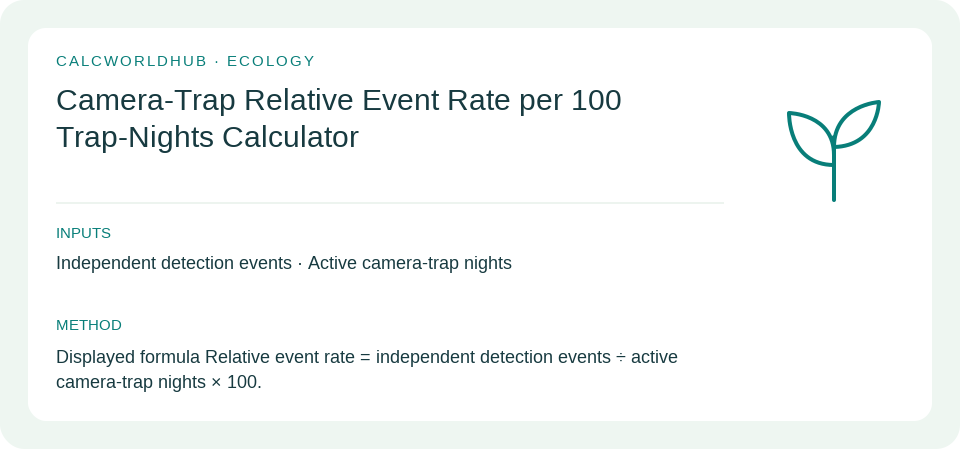
Normalize independent wildlife detections to 100 active camera-trap nights.
- Enter Independent detection events, Active camera-trap nights. Match the units shown beside each field and review the result together with the assumptions below.
- Read the worked example below to check the expected input format and result.
- Compare another scenario by changing one input at a time. Use Reset to return to the starting values.
How this calculation works
This relative event index standardizes a defined set of independent detections by camera effort. Count active nights rather than calendar nights when cameras were out of service, and document the event-independence rule before tallying photographs or videos.
Inputs and units
independentDetectionEvents— Independent detection events- Events for the target species after applying the study’s pre-defined independence rule.
activeCameraTrapNights— Active camera-trap nights- Sum of nights each camera was operational during the selected survey.
Formula
Relative event rate = independent detection events ÷ active camera-trap nights × 100.
Method
Use the same species identification, independence interval, deployment period, and uptime convention for every comparison.
Worked example
A survey recorded 18 independent events over 240 active camera-trap nights. The relative event rate is 7.50 events per 100 trap-nights.
Assumptions and limits
The index describes recorded event rate per unit of effort. Camera placement, detection probability, animal behavior, and event rules affect the result; it is not a population density estimate.
Frequently asked questions
What is an independent event?
A detection counted under a pre-defined time or observation rule that separates repeated triggers from distinct events.
How is camera downtime handled?
Exclude nights when a camera was not operational from active camera-trap effort.
Does this estimate wildlife abundance?
No. It is a relative detection index and is affected by placement and detection probability.
How do I use the Camera-Trap Relative Event Rate per 100 Trap-Nights Calculator?
Enter Independent detection events, Active camera-trap nights. Match the units shown beside each field and review the result together with the assumptions below.
What is a worked example of Camera-Trap Relative Event Rate per 100 Trap-Nights?
A survey recorded 18 independent events over 240 active camera-trap nights. The relative event rate is 7.50 events per 100 trap-nights.
Reference: National Athletic Trainers’ Association fluid-replacement position statement. See our calculation methodology.